

Design Science Research Methods and Patterns: Innovating Information and Communication Technology
Vijay K. Vaishnavi,William Kuechler Jr.
2007
View book
Book guide and evaluation
Jeanne Liedtka;Randy Salzman;Daisy Azer
0 reviews
Published
pages
views
In today's rapidly evolving world, the social sector is continuously challenged to do more with less, requiring innovative approaches that can spur genuine progress and create sustainable impact. "Design Thinking for the Greater Good: Innovation in the Social Sector" offers a
Before you read
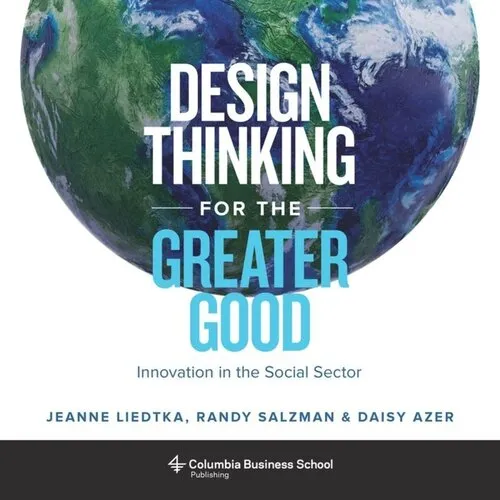
In today's rapidly evolving world, the social sector is continuously challenged to do more with less, requiring innovative approaches that can spur genuine progress and create sustainable impact. "Design Thinking for the Greater Good: Innovation in the Social Sector" offers a beacon of innovation, providing a transformative approach to tackling some of the complex challenges faced by organizations working for social change.
Design thinking, originally popularized in the business world for its user-centric philosophy and creative problem-solving techniques, is making waves in the social sector. This book, by Jeanne Liedtka, Randy Salzman, and Daisy Azer, delves deep into how design thinking can be leveraged to unlock new levels of performance and innovation to address pressing societal issues.
The book explores multiple case studies where design thinking has been effectively applied in organizations that prioritize social impact over profit. From government agencies to nonprofit organizations, these examples illustrate how deeply understanding the needs of constituents can lead to innovative solutions that are more effective and sustainable. Through the lens of real-world applications, the authors dismantle misconceptions about design thinking and demonstrate its potential in fostering creativity, empathy, and collaboration.
"Design thinking helps armed us with the tools to paint a new tapestry of possibility over the canvas of entrenched challenges." – Jeanne Liedtka
"Empathy is at the heart of design. Without the understanding of what others see, feel, and experience, design is a pointless task." – Randy Salzman
"Innovation is fueled by observing the ordinary and finding the extraordinary." – Daisy Azer
As the demands on the social sector increase and resources become more constrained, there is an urgent need for innovation in how problems are approached and solved. This book is crucial not only for its introduction of design thinking into the social sector but also for its practical applications and relatable case studies.
It empowers change-makers, policymakers, leaders, and anyone involved in social impact initiatives to rethink traditional problem-solving methods. By showcasing the transformative potential of design thinking, the authors provide a roadmap for fostering creativity and collaboration. This approach leads to solutions that are not only innovative but also sustainable and scalable.
In essence, "Design Thinking for the Greater Good" is more than a guide—it's an invitation to create meaningful change in a world that desperately needs it.
Your question is answered in the context of this title and author. Each answer uses 2 points.
0 reviews, 4.8 average out of 5
Sign in to publish a review.
Ask a focused question and learn from the community.
Related references that continue this learning path.
Vijay K. Vaishnavi,William Kuechler Jr.

David B. Allison (Editor),Grier P. Page (Editor),T. Mark Beasley (Editor),Jode W. Edwards (Editor


Frank C. Hoppensteadt,Charles S. Peskin (auth.)