Book guide and evaluation
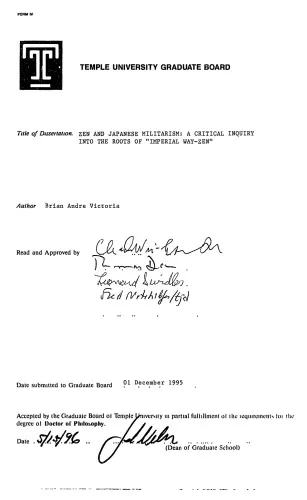
Zen and Japanese Militarism: A Critical Inquiry Into the Roots of 'Imperial Way-Zen'
Brian Andre Victoria
English
Intermediate
novel
4.3 / 5
0 reviews
1995
Published
459
pages
541
views
Introduction Welcome to an engaging exploration of 'Zen and Japanese Militarism: A Critical Inquiry Into the Roots of "Imperial Way-Zen"'. This book delves deeply into the complex intertwining of Zen Buddhism and Japanese militarism, a topic that has long sparked discussion an
Before you read
What will you get from this book?
Introduction
Welcome to an engaging exploration of 'Zen and Japanese Militarism: A Critical Inquiry Into the Roots of "Imperial Way-Zen"'. This book delves deeply into the complex intertwining of Zen Buddhism and Japanese militarism, a topic that has long sparked discussion and controversy among historians, religious scholars, and practitioners of Zen alike.
Detailed Summary of the Book
In this critical exploration, the book investigates the historical period starting from the late 19th century to the end of World War II, a time when Japan's aggressive militarism became tightly interwoven with Zen Buddhism. The text examines how various Zen masters and monks contributed to and justified the military ethos of Imperial Japan, fostering a mindset that revered the sword as much as spiritual enlightenment.
The book scrutinizes the philosophical and ethical underpinnings of the term "Imperial Way-Zen," which sought to harmonize samurai culture and Zen teachings to promote the emperor's cause. By meticulously analyzing historical texts, sermons, and wartime propaganda, the narrative unveils the active role played by some Zen institutions and leaders in endorsing warfare and contributing to the militaristic spirit of the era.
Key Takeaways
- Zen Buddhism was not inherently pacifistic and has a complex history with Japanese militarism.
- Several prominent Zen figures supported Japanese wartime efforts, showing the moral ambiguities within certain teachings.
- Understanding the historical context of Zen's militaristic interpretations can lead to a deeper appreciation of modern pacifist movements within the tradition.
- The book challenges readers to reconsider widely held assumptions about the compatibility of Zen practices with political and military agendas.
Famous Quotes from the Book
"The sword that kills is also the sword that gives life." - A metaphor employed by Zen masters to convey the duality of violence and spiritual enlightenment.
"To die a selfless death in service of the emperor is the highest form of Buddhist practice." - This illustrates how certain teachings were manipulated to validate military loyalty.
Why This Book Matters
This book holds significant importance for multiple reasons. First, it sheds light on a pivotal yet controversial nexus between a renowned spiritual tradition and militaristic fervor, urging contemporary practitioners and scholars to come to terms with the past. It emphasizes the responsibility of religious institutions to uphold ethical integrity, especially in times of nationalistic pressure.
Furthermore, it contributes to broader historical and philosophical discussions about the role of religion in societal and nationalistic conflicts. In an era where militarism and ideological extremism threaten global peace, this analysis prompts a necessary reflection on how spiritual teachings can either be co-opted for violent purposes or serve as a foundation for peace-building efforts.
Ask this book
Your question is answered in the context of this title and author. Each answer uses 2 points.
Sign in to ask the book assistant.
Reader reviews
0 reviews, 4.3 average out of 5
No reviews yet
If you have read this book, help the next reader with your experience.
Write a review
Sign in to publish a review.
Reader questions and answers
Ask a focused question and learn from the community.
Sign in to ask or answer a question.
No questions yet
Be the first to ask a clear, useful question.
What to read next
Related references that continue this learning path.


Angels in Medieval Philosophical Inquiry: Their Function and Significance
Martin Lenz,Isabel Iribarren
2008
View book