
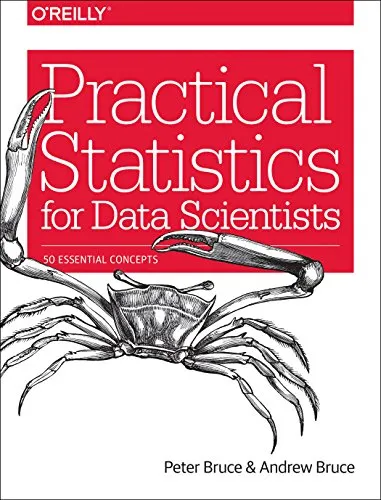
Practical Statistics for Data Scientists: 50 Essential Concepts
Peter Bruce,Andrew Bruce
2017
View book
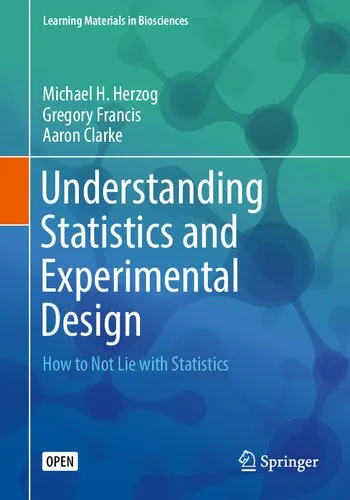
Book guide and evaluation
Michael H. Herzog,Gregory Francis,Aaron Clarke
0 reviews
Published
pages
views
Introduction Welcome to "Understanding Statistics and Experimental Design: How to Not Lie with Statistics," a cornerstone for anyone eager to master the complexities of statistics and its essential role in the scientific method. Written by Michael H. Herzog, Gregory Franci
Before you read
Welcome to "Understanding Statistics and Experimental Design: How to Not Lie with Statistics," a cornerstone for anyone eager to master the complexities of statistics and its essential role in the scientific method. Written by Michael H. Herzog, Gregory Francis, and Aaron Clarke, this book serves as a comprehensive guide for students, researchers, and professionals in the biosciences. Our objective is to empower readers with the skills to interpret, design, and communicate results with integrity and precision.
In today’s data-driven world, statistics holds the key to unlocking the secrets hidden within data. However, it’s all too easy to misuse statistics, whether deliberately or inadvertently. Our book aims to rectify this by providing a solid foundation in statistical principles, combined with guidance on how to design robust experiments. We start by exploring basic statistical concepts such as data types, distributions, probabilistic models, and hypothesis testing. From there, we delve into more advanced topics such as regression analysis, ANOVA, and multivariate statistics, ensuring that readers can tackle a wide array of analytical challenges.
Importantly, we emphasize the ethics of statistical practice, guiding readers on how to present data truthfully and transparently. Our aim is to educate readers on the common pitfalls and deceptive practices that can arise, intentionally or otherwise, in statistical reporting.
"Statistics is the grammar of science. To comprehend the complexities of the natural world, one must first understand the language it speaks."
"The power of a statistician lies not in their ability to calculate complex formulas but in their resolve to present data honestly and clearly."
In an era where data significantly influences decision-making and scientific advancement, this book is critical for fostering a culture of accuracy and honesty in research. Misuse of statistics not only leads to scientific misconduct but can also have real-world implications, affecting public policy, healthcare, and technological development.
"Understanding Statistics and Experimental Design" is a valuable resource that encourages readers to go beyond number-crunching. It prepares them to become credible, ethical contributors to their respective fields. Through illustrative examples, practical exercises, and robust theoretical insights, this book prepares leaders in the biosciences to not only understand data but to wield it responsibly. Our collective future sees an increasingly data-centric world, and this book ensures that its readers are not just participants but informed and ethical leaders in this transformation.
Your question is answered in the context of this title and author. Each answer uses 2 points.
0 reviews, 4.5 average out of 5
Sign in to publish a review.
Ask a focused question and learn from the community.
Related references that continue this learning path.
Peter Bruce,Andrew Bruce
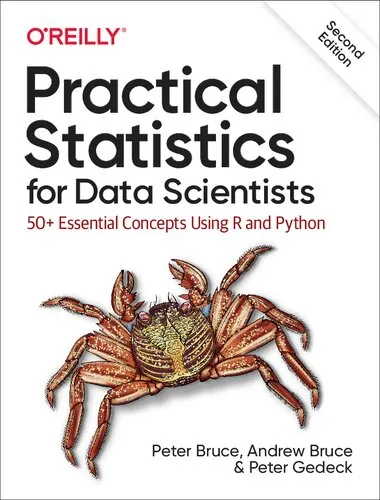
Peter Bruce,Andrew Bruce,Peter Gedeck
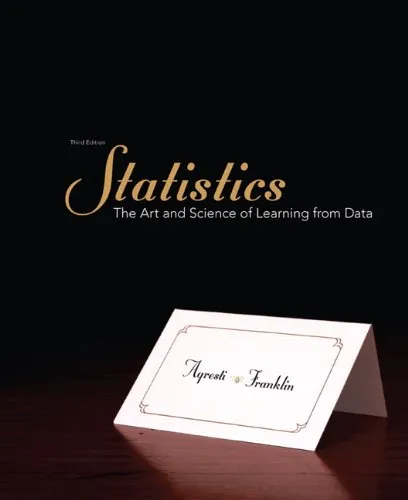
Alan Agresti,Christine Franklin
Bertrand Russell