
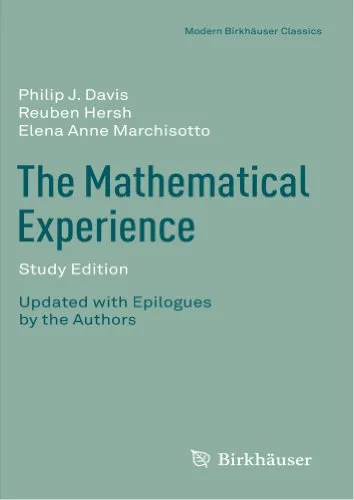
The Mathematical Experience, Study Edition
Philip J. Davis,Reuben Hersh,Elena Anne Marchisotto (auth.)
2012
View book
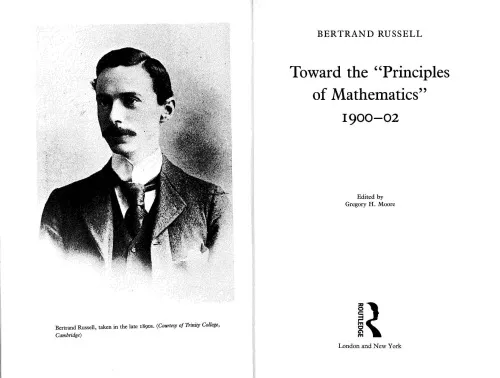
Book guide and evaluation
Bertrand Russell
0 reviews
Published
pages
views
Introduction to 'Collected Papers, vol. 3: Towards the ’Principles of Mathematics’ 1900-1902' This volume, part of the celebrated Collected Papers of Bertrand Russell series, offers an intellectual journey into the development of mathematical logic and the philosophical fo
Before you read
This volume, part of the celebrated Collected Papers of Bertrand Russell series, offers an intellectual journey into the development of mathematical logic and the philosophical foundations of mathematics as they were shaping my thoughts during the period 1900–1902. It is a mosaic of essays, notes, and letters written in pursuit of clarifying the intricacies of mathematics and logic, eventually culminating in my seminal work, The Principles of Mathematics.
The work presented here reflects not merely a set of inquiries but a decisive period in my intellectual life—a time driven by both challenges and triumphs. It seeks to bridge mathematics and philosophy through logical rigor while answering fundamental questions about the nature of numbers, sets, and truth. As such, this volume remains essential for those seeking to understand my contributions not only to mathematics but also to the broader landscape of analytic philosophy.
The volume compiles a variety of works produced between 1900 and 1902. It is during this period that I confronted and sought to address the foundational problems of mathematics, advocating for a systematic and principled approach inspired largely by formal logic.
Through meticulous essays and detailed analysis, I delve into topics such as the relationship between arithmetic and logic, the role of sets (or classes) in mathematics, and the properties of number theory. Notably, I engage with themes introduced by earlier logicians such as Frege, expanding upon their ideas while responding to emerging challenges—most crucially, the paradoxes that would ultimately inform my later work on type theory.
Key sections also highlight my correspondence with figures like Giuseppe Peano, whose notational system profoundly influenced my thinking. My early attempts to reconcile foundational mathematical principles with logical structure can be observed, paving the way for The Principles of Mathematics, which I published in 1903. These documents together illustrate my unwavering focus on precision, coherence, and the elimination of ambiguity in reasoning.
In essence, the volume captures the evolution of my thought, laying the groundwork for future milestones in both logic and mathematics.
The significance of Collected Papers, vol. 3 extends far beyond its context as an introduction to The Principles of Mathematics. It offers an indispensable glimpse into the formation of ideas that have since influenced disciplines ranging from logic and set theory to computer science and philosophy.
For scholars and enthusiasts, this volume showcases the birth of philosophical analysis as it intersects with mathematical formalization. It underscores the central role of logical examination in creating a consistent and universally applicable foundation for mathematics. Moreover, by addressing and attempting to resolve paradoxes early in my career, these works laid the groundwork for the eventual evolution of my contributions to symbolic logic and analytic philosophy.
Above all, it is a testament to the intellectual rigor and dedication required to challenge long-standing assumptions and push the boundaries of knowledge. This volume constitutes a crucial chapter in understanding the trajectory of modern logic and mathematics. It stands as an enduring reflection of the beauty and rigor inherent in intellectual pursuit.
Your question is answered in the context of this title and author. Each answer uses 2 points.
0 reviews, 4.8 average out of 5
Sign in to publish a review.
Ask a focused question and learn from the community.
Related references that continue this learning path.
Philip J. Davis,Reuben Hersh,Elena Anne Marchisotto (auth.)
Wesley C. Salmon (editor),Gereon Wolters (editor)
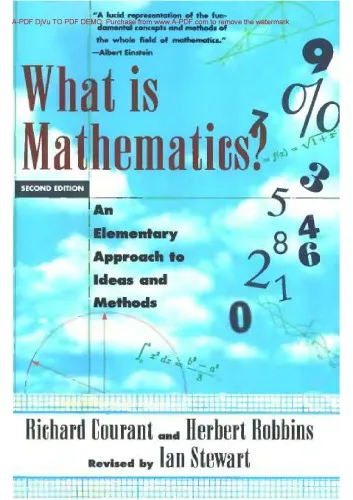
Courant, Richard;Robbins, Herbert