UML 2.0 and the unified process: practical object-oriented analysis and design
Arlow, Jim;Neustadt, Ila
2009
View book
Book guide and evaluation
Howard (Howard Podeswa) Podeswa
0 reviews
Published
pages
views
Introduction to 'UML For The IT Business Analyst, Second Edition' Welcome to the comprehensive guide on leveraging UML in the realm of business analysis. 'UML For The IT Business Analyst, Second Edition' is an essential companion for IT professionals seeking to
Before you read
Welcome to the comprehensive guide on leveraging UML in the realm of business analysis. 'UML For The IT Business Analyst, Second Edition' is an essential companion for IT professionals seeking to enhance their expertise in Unified Modeling Language (UML) and apply it effectively within their projects.
The second edition of 'UML For The IT Business Analyst' offers IT business analysts and other stakeholders a deep dive into the capabilities of UML. It bridges the gap between technical UML conventions and business analysis by interpreting UML models in ways that are accessible to the business community. Using the latest UML standards, the book ensures that readers receive updated and relevant knowledge, applicable to modern business analysis scenarios.
This edition focuses on empowering business analysts to use UML diagrams to gather and specify requirements, communicate more clearly with stakeholders, and improve their role within system development projects. Through detailed examples, practical exercises, and case studies, readers learn to apply UML in a context that supports effective business analysis.
"Understanding UML isn't just about mastering a language; it's about enhancing communication to create better software."
"A model is not just a set of diagrams; it's a tool for discovery, elucidation, and collaboration."
'UML For The IT Business Analyst, Second Edition' matters because it fills a unique niche in the world of business analysis and systems development. As process and technology evolve, the need for sound tools that promote understanding and efficiency between teams becomes ever more critical. UML serves as a pivotal bridge in this regard, facilitating better project outcomes through clearer dialogue and structured documentation.
The book is notably significant for its focus on the practical application of UML within the business analysis field—an area often overshadowed by the technical aspects of system development. By concentrating on how UML can help in understanding and mapping business processes, this book empowers analysts to be more than mere translators of requirements; it positions them as key contributors to project success. It is thus an invaluable resource for anyone looking to advance their career and impact the outcome of IT projects positively.
Your question is answered in the context of this title and author. Each answer uses 2 points.
0 reviews, 4.5 average out of 5
Sign in to publish a review.
Ask a focused question and learn from the community.
Related references that continue this learning path.
Arlow, Jim;Neustadt, Ila
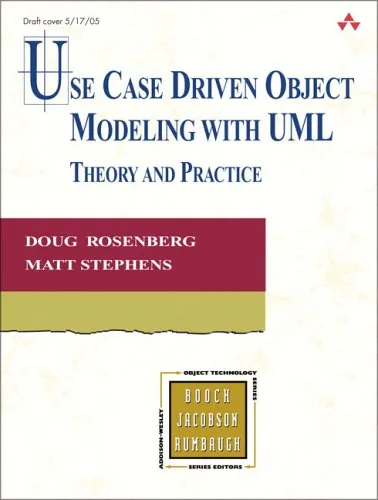
Doug Rosenberg,Matt Stephens