
UML 2.0 and the unified process: practical object-oriented analysis and design
Arlow, Jim;Neustadt, Ila
2009
View book
Book guide and evaluation
Jacobson, Ivar;Booch, Grady;Rumbaugh, James
0 reviews
Published
pages
views
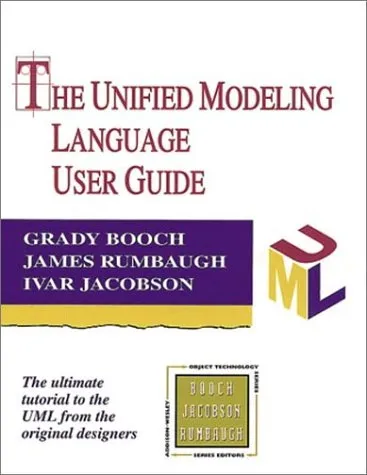
Introduction to 'The Unified Modeling Language User Guide' Welcome to a comprehensive dive into the world of software engineering with 'The Unified Modeling Language User Guide' – a seminal work that introduces readers to the intricacies and powerful workings of the Unif
Before you read
Welcome to a comprehensive dive into the world of software engineering with 'The Unified Modeling Language User Guide' – a seminal work that introduces readers to the intricacies and powerful workings of the Unified Modeling Language (UML). Authored by experts in the field, Jacobson, Ivar; Booch, Grady; and Rumbaugh, James, this guide is indispensable for software developers, engineers, and anyone keen on mastering UML for effective software modeling and design.
UML, or Unified Modeling Language, has become the de facto standard in the visual representation of software architecture. This user guide provides an exhaustive look into the UML landscape, illustrated through practical examples and guidance. The book is structured to give an incremental understanding of UML, evolving from the basics to more advanced concepts.
The authors, renowned specialists in their domains, systematically walk the reader through different UML diagrams like class diagrams, use case diagrams, and sequence diagrams. Each chapter builds upon the last, ensuring the reader gains a holistic understanding of not only the syntax and semantics of UML but also the pragmatic application of these models in real-world scenarios.
With a clear focus on object-oriented design, the user guide paints a vivid picture of how UML can be leveraged throughout the software development lifecycle, from requirements gathering and analysis through to system design and deployment. It drives home the importance of visual modeling in encapsulating complex software architecture, making it an invaluable tool for communication among team members and stakeholders.
"UML is about envisioning a world where complex systems can be described in a way that is consistent across the disciplines."
"A model is a simplification of reality that allows us to comprehend and tackle the intricacies of complex systems."
In the rapidly evolving domain of software engineering, having a standard that facilitates the consistent representation of complex system architectures is critical. This book not only introduces UML but also champions its role as a unifying language in software design and modeling. As organizations continue to build intricate systems, this book serves as a beacon for professionals who wish to stay at the forefront of technology and design.
By providing practical guidance supported by real-world examples, the authors ensure that UML is approachable for beginners while still offering depth for seasoned professionals seeking to refine their skills. Its relevance extends beyond individuals to teams and organizations striving for greater efficiency and clarity in their development processes.
In summary, 'The Unified Modeling Language User Guide' is not just a book; it's a guide for mastering the art and science of software modeling in the contemporary digital landscape.
Your question is answered in the context of this title and author. Each answer uses 2 points.
0 reviews, 4.0 average out of 5
Sign in to publish a review.
Ask a focused question and learn from the community.
Related references that continue this learning path.
Arlow, Jim;Neustadt, Ila
Doug Rosenberg,Matt Stephens
Grady Booch,James Rumbaugh,Ivar Jacobson