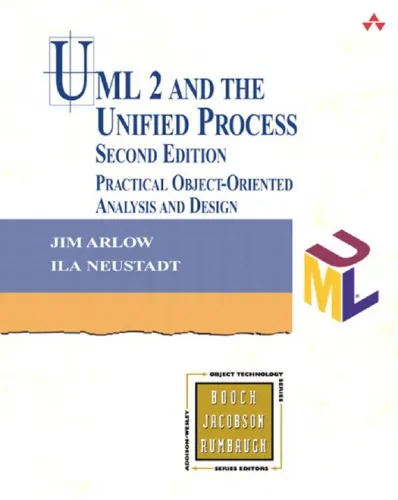
UML 2.0 and the unified process: practical object-oriented analysis and design
Arlow, Jim;Neustadt, Ila
2009
View book
Book guide and evaluation
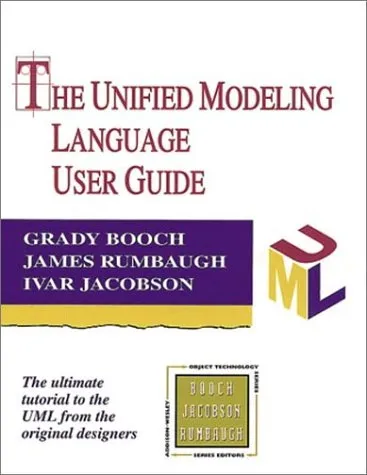
Grady Booch,James Rumbaugh,Ivar Jacobson
0 reviews
Published
pages
views
Introduction Welcome to the comprehensive guide for navigating the intricate realm of the Unified Modeling Language (UML). "The Unified Modeling Language User Guide" is an essential resource designed to help software developers, analysts, and architects unlock the full potenti
Before you read
Welcome to the comprehensive guide for navigating the intricate realm of the Unified Modeling Language (UML). "The Unified Modeling Language User Guide" is an essential resource designed to help software developers, analysts, and architects unlock the full potential of UML for effective modeling and documentation of systems.
The Unified Modeling Language User Guide, authored by Grady Booch, James Rumbaugh, and Ivar Jacobson, serves as a definitive manual for understanding and applying UML in software development projects. The book is part of the esteemed Addison-Wesley Object Technology Series and offers a structured breakdown of UML's capabilities.
It begins by articulating the principles of object-oriented analysis and design, which are fundamental to UML. The guide then navigates through the various diagrams and modeling techniques offered by UML, providing practical examples and case studies. These include class diagrams, use case diagrams, sequence diagrams, activity diagrams, and more. Each section is enriched with real-world applications and illustrative examples that echo the authors' extensive expertise in object-oriented technologies.
Beyond the fundamentals, the User Guide delves into advanced UML concepts, including extension mechanisms and profiles. It also addresses best practices for managing large models and iterative development processes, ensuring readers gain a holistic understanding of UML's capabilities within the software development lifecycle.
"The UML is more than a mere collection of sketchy diagrams; it's a precise language for expressing software architecture in visual form."
"In software engineering, both rigor and creativity are necessary to produce effective designs."
The Unified Modeling Language User Guide is a cornerstone text for anyone serious about mastering software design and architecture through UML. With the ever-growing complexity of software systems, UML provides a standardized way to visualize the design of a system. This book matters because it equips readers with the skills to create, document, and understand the architecture and interactions within software at a level of precision required by high-stakes development environments.
Additionally, the authors, Booch, Rumbaugh, and Jacobson, have been instrumental in developing the UML standard itself, which adds unparalleled authority and clarity to their exposition. By learning from the originators of UML, readers can avoid common pitfalls and adopt industry best practices with confidence.
In an industry that constantly evolves, staying up-to-date with tools like UML ensures professionals can manage changes efficiently and communicate effectively across diverse teams. Overall, this guide is an invaluable asset for personal development, offering insights that resonate with both newcomers and seasoned practitioners aiming to refine their craft.
Your question is answered in the context of this title and author. Each answer uses 2 points.
0 reviews, 4.5 average out of 5
Sign in to publish a review.
Ask a focused question and learn from the community.
Related references that continue this learning path.
Arlow, Jim;Neustadt, Ila
Doug Rosenberg,Matt Stephens