Book guide and evaluation
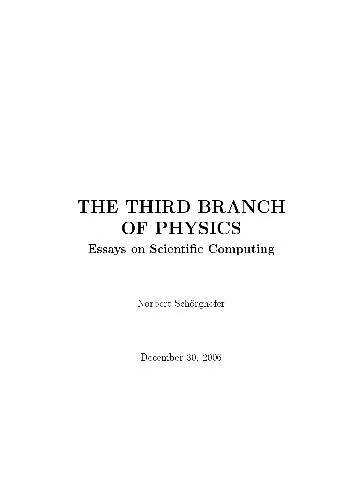
The third branch of physics: essays in scientific computing (web draft, Dec. 2006)
Schoerghofer N.
English
Beginner
Applied Mathematics
4.7 / 5
0 reviews
-
Published
95
pages
424
views
Introduction to "The Third Branch of Physics: Essays in Scientific Computing" Welcome to the fascinating world of scientific computing, a pivotal area of study that forms the "third branch" of physics alongside experimental and theoretical exploration. My book, "The Third
Before you read
What will you get from this book?
Introduction to "The Third Branch of Physics: Essays in Scientific Computing"
Welcome to the fascinating world of scientific computing, a pivotal area of study that forms the "third branch" of physics alongside experimental and theoretical exploration. My book, "The Third Branch of Physics: Essays in Scientific Computing," delves into this critical and evolving field, providing a comprehensive elucidation of how computational methods have become integral to scientific discovery and innovation. This introduction aims to familiarize you with the essence of the book, its significance, and the many insights it offers to readers across various scientific disciplines.
Detailed Summary of the Book
Scientific computing has revolutionized how we understand and interact with the complex phenomena of the universe. Throughout the book, I explore the historical development, foundational principles, and future trajectory of computational physics. I examine how computers have transcended their roles as mere number-crunching tools to become essential partners in modeling and simulation, enabling us to tackle problems once deemed intractable.
The book is a collection of essays that not only chart the growth of scientific computing but also highlight its multidisciplinary applications. I cover topics ranging from computational methods in fluid dynamics to quantum mechanics simulations, each illustrating the profound impact of computation on advancing our scientific frontiers. Each essay is crafted to educate, inspire, and provoke thought, offering both practitioners and newcomers to the field a robust understanding of scientific computing's potential.
Key Takeaways
- Scientific computing is a crucial and expanding field that bridges theory and experimentation.
- Computational models and simulations provide unparalleled insights into large-scale and complex systems.
- The interdisciplinary nature of scientific computing promotes collaboration across different scientific domains.
- Advances in hardware and algorithms continuously push the boundaries of what can be simulated and understood.
- The book discusses the ethical implications of computational decisions and their impacts on scientific integrity.
Famous Quotes from the Book
"In the realm of scientific inquiry, to compute is to understand; encompassing the ability to simulate the universe on our terms."
"The algorithms we devise today are the experiments we observe tomorrow."
Why This Book Matters
The importance of this book cannot be overstated in an era where digitization and high-performance computing play pivotal roles in every scientific sphere. "The Third Branch of Physics" serves as both a scholarly resource and inspiration, encouraging a deeper engagement with scientific computing. This text is especially significant for students and early-career scientists who are increasingly reliant on computational tools yet may lack a comprehensive understanding of their potential and limitations. Moreover, for established researchers, the book presents a thorough examination of new computational paradigms, stimulating innovation and critical thought.
By underscoring the integration of computation in scientific research, the book acts as a clarion call for more investment in computational education and infrastructure. It challenges traditional boundaries between disciplines, advocating for a more holistic approach to science where computation serves as a unifying thread. Whether you're a physicist, a computer scientist, or an enthusiast of scientific methodologies, this book offers invaluable insights into the transformative power of computation in expanding the horizons of knowledge.
Ask this book
Your question is answered in the context of this title and author. Each answer uses 2 points.
Sign in to ask the book assistant.
Reader reviews
0 reviews, 4.7 average out of 5
No reviews yet
If you have read this book, help the next reader with your experience.
Write a review
Sign in to publish a review.
Reader questions and answers
Ask a focused question and learn from the community.
Sign in to ask or answer a question.
No questions yet
Be the first to ask a clear, useful question.
What to read next
Related references that continue this learning path.
Data-Driven Science and Engineering: Machine Learning, Dynamical Systems, and Control
Steven L. Brunton,J. Nathan Kutz
2019
View book