Book guide and evaluation
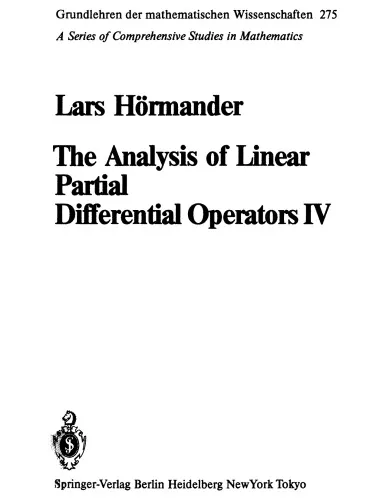
The analysis of linear partial differential operators
Lars Hörmander
English
Beginner
Applied Mathematics
4.8 / 5
0 reviews
1985
Published
359
pages
564
views
Introduction to "The Analysis of Linear Partial Differential Operators" Lars Hörmander's seminal work, "The Analysis of Linear Partial Differential Operators," stands as a monumental contribution to the field of mathematics, particularly in the realm of partial differentia
Before you read
What will you get from this book?
Introduction to "The Analysis of Linear Partial Differential Operators"
Lars Hörmander's seminal work, "The Analysis of Linear Partial Differential Operators," stands as a monumental contribution to the field of mathematics, particularly in the realm of partial differential equations (PDEs). This comprehensive treatise delves deep into the analytical foundations and methodologies for understanding and solving linear PDEs, a core component of mathematical physics, engineering, and applied mathematics.
Detailed Summary of the Book
The book is meticulously structured into several volumes, each targeting specific aspects of linear partial differential operators. It begins with the introduction of distribution theory, Sobolev spaces, and various functional analytic frameworks that underpin the study of PDEs. Hörmander guides the reader through the intricate aspects of Fourier analysis, microlocal analysis, and pseudodifferential operators. Progressively, the text delves into deeper territories such as hypoellipticity, homogeneity, and singularity propagation. By synthesizing both classical techniques and modern advancements, Hörmander provides a nuanced view of linear PDEs, addressing both local and global solution theories. Throughout its volumes, the work focuses on the rigorous mathematical proofs and exercises that facilitate a robust understanding of the subject.
Key Takeaways
- Comprehensive Framework: Offers an exhaustive exploration of linear PDEs from basic concepts to advanced topics.
- Analytical Techniques: Introduces essential tools such as microlocal analysis and pseudodifferential operators.
- Theoretical Depth: Combines rigorous proofs with theoretical explanations, catering to both beginner and advanced scholars.
- Versatile Applications: Encompasses various applications to physics, engineering, and applied sciences, highlighting the relevance of linear PDEs.
Famous Quotes from the Book
"Understanding the behavior of solutions to partial differential equations is a pre-requisite to extracting meaningful information from mathematical models in science."
"The intricate tapestry of theory, computation, and application in PDEs weaves the very fabric of mathematical analysis."
Why This Book Matters
Hörmander's "The Analysis of Linear Partial Differential Operators" is not merely a textbook; it is an indispensable resource that has shaped the modern landscape of mathematical analysis. Its influence extends across various domains where PDEs are pivotal, reinforcing the book's role as a key reference and teaching tool worldwide. The comprehensive nature of the text supports academia by offering a deep insight into the structure and solutions of linear PDEs, while also sparking further research and exploration. For students and researchers alike, Hörmander's work is a foundational pillar, fostering a greater appreciation and understanding of the analytical complexities involved in PDEs.
In summary, the book is revered for its clarity, depth, and scope. It offers a systematic approach to the analysis of PDEs, making it an essential read for those engaged in the mathematical sciences. Its meticulous attention to detail and expansive coverage ensure it remains a timeless guide for generating new insights into the mathematical world.
Ask this book
Your question is answered in the context of this title and author. Each answer uses 2 points.
Sign in to ask the book assistant.
Reader reviews
0 reviews, 4.8 average out of 5
No reviews yet
If you have read this book, help the next reader with your experience.
Write a review
Sign in to publish a review.
Reader questions and answers
Ask a focused question and learn from the community.
Sign in to ask or answer a question.
No questions yet
Be the first to ask a clear, useful question.
What to read next
Related references that continue this learning path.
Data-Driven Science and Engineering: Machine Learning, Dynamical Systems, and Control
Steven L. Brunton,J. Nathan Kutz
2019
View book