
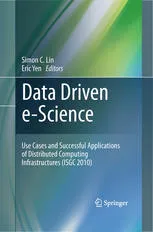
Data Driven e-Science: Use Cases and Successful Applications of Distributed Computing Infrastructures (ISGC 2010)
Francois Grey,Simon C. Lin (auth.),Simon C. Lin,Eric Yen (eds.)
2011
View book
Book guide and evaluation
G. Cavvazini
0 reviews
Published
pages
views
The Particle Image Velocimetry - Characteristics, Limits, and Possible Applications Welcome to a comprehensive exploration of one of the most transformative tools in experimental fluid dynamics—Particle Image Velocimetry (PIV). This book aims to bridge the gap betwee
Before you read
Welcome to a comprehensive exploration of one of the most transformative tools in experimental fluid dynamics—Particle Image Velocimetry (PIV). This book aims to bridge the gap between theoretical knowledge and practical implementation of PIV, providing readers with a holistic understanding of its principles, capabilities, limitations, and potential applications across various scientific and engineering fields. Whether you are a researcher, a practicing engineer, or an enthusiastic learner, "The Particle Image Velocimetry - Characteristics, Limits, and Possible Applications" offers valuable insights on how this technique has shaped our ability to analyze fluid flows with remarkable precision and detail.
Particle Image Velocimetry (PIV) is a non-intrusive, optical measurement technique that has revolutionized fluid dynamics research. This book begins by introducing the foundational principles behind PIV, including the physics of particle seeding, laser illumination, and image acquisition. It delves deeply into the computational algorithms that analyze captured images to extract instantaneous velocity fields, emphasizing their mathematical underpinnings and operational parameters.
The core chapters dissect PIV's versatility, covering its variations such as Stereo-PIV, Time-Resolved PIV, and Micro-PIV. The text provides detailed discussions on their respective technical constraints, offering guidance on selecting the appropriate PIV methodology for a given application. Numerous examples from fields like aerodynamics, biomedical engineering, and environmental sciences serve to illustrate the broad applicability of PIV.
To foster a balanced perspective, the book does not shy away from discussing the intrinsic limitations of PIV. Factors like seeding density, optical distortions, velocity gradient resolution, and post-processing challenges are critically examined. These sections ensure that readers approach PIV not just as a tool, but as a nuanced instrument with specific requirements and challenges.
The final segments of the book are forward-looking, exploring potential advancements in PIV driven by technological innovation. Topics such as artificial intelligence in flow analysis, advancements in camera and laser technologies, and the integration of PIV with other diagnostic tools are discussed, offering a glimpse into the future directions of this technique.
"PIV does not simply measure flow; it visualizes the hidden stories within fluid streams, rendering the invisible visible and the chaotic comprehensible."
"Every technique comes with its limits. Understanding these is not a hindrance but a path to mastery."
"In the hands of a skilled practitioner, PIV becomes more than a tool—it becomes an extension of one’s scientific intuition."
The importance of this book lies in its ability to provide a nuanced, multi-faceted perspective on PIV, a cornerstone of modern experimental fluid dynamics. While numerous academic papers and technical articles exist on this topic, very few provide such a well-rounded approach, combining theory, practical insights, and a forward-looking perspective.
By reading this book, you will gain not just the theoretical knowledge needed to understand PIV but also the practical skills to implement it effectively in real-world scenarios. Moreover, the detailed discussions on potential pitfalls and limitations empower you with the foresight to anticipate and address challenges proactively.
As fluid flows govern countless phenomena—from the aerodynamics of aircraft to the circulation of blood in human bodies—the ability to analyze these flows with precision is paramount. This book serves as a valuable resource for advancing both fundamental research and practical engineering applications.
Your question is answered in the context of this title and author. Each answer uses 2 points.
0 reviews, 3.9 average out of 5
Sign in to publish a review.
Ask a focused question and learn from the community.
Related references that continue this learning path.
Francois Grey,Simon C. Lin (auth.),Simon C. Lin,Eric Yen (eds.)

John N. Mordeson,Sunil Mathew,Davender S. Malik