Data Driven e-Science: Use Cases and Successful Applications of Distributed Computing Infrastructures (ISGC 2010)
Francois Grey,Simon C. Lin (auth.),Simon C. Lin,Eric Yen (eds.)
2011
View book
Book guide and evaluation
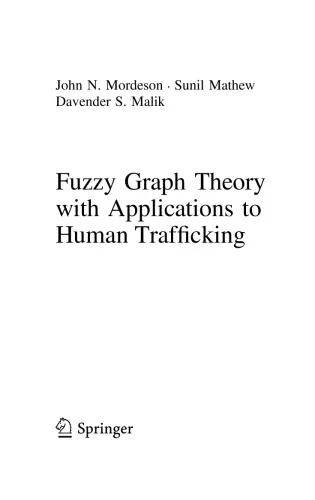
John N. Mordeson,Sunil Mathew,Davender S. Malik
0 reviews
Published
pages
views
Introduction "Fuzzy Graph Theory with Applications to Human Trafficking" is a pivotal work that explores the intersection of mathematical theory and one of the foremost human rights issues of our time. The book introduces readers to the nuanced realms of fuzzy grap
Before you read
"Fuzzy Graph Theory with Applications to Human Trafficking" is a pivotal work that explores the intersection of mathematical theory and one of the foremost human rights issues of our time. The book introduces readers to the nuanced realms of fuzzy graph theory, while simultaneously shedding light on its profound applications in understanding and potentially curbing human trafficking. Authored by John N. Mordeson, Sunil Mathew, and Davender S. Malik, this text serves as both an academic resource and a call to action for analysts, researchers, and policy makers.
At its core, the book elucidates the concepts and tools provided by fuzzy graph theory. It begins with a comprehensive overview of graph theory fundamentals before delving into the intricacies of fuzzy sets and fuzzy logic. The authors meticulously outline how these mathematical concepts can be adapted to model real-world problems, notably the complex networks inherent in human trafficking.
Subsequent chapters detail the construction and application of fuzzy graphs tailored to simulate the interconnections and dependencies characteristic of trafficking networks. By leveraging these models, the book demonstrates how to identify patterns and vulnerabilities within these nefarious systems. Ultimately, the aim is to equip readers with powerful analytical tools to aid in the dismantling of trafficking operations.
"Mathematics alone cannot solve human trafficking, but it provides a lens through which we can see the unseen, predict the unpredictable, and dismantle the entrenched."
"In the shadows of society, fuzzy logic unveils clarity, illuminating paths to justice and reform."
This book stands at the junction of mathematics and social justice, advocating for the use of sophisticated analytical tools to tackle urgent humanitarian challenges. Through innovative applications of fuzzy graph theory, the authors illuminate pathways to understanding and combating human trafficking's complex networks.
As human trafficking continues to exploit millions globally, the importance of academic and practical resources targeting its eradication cannot be understated. This work embodies a bold interdisciplinary approach, urging collaboration among mathematicians, social scientists, and policymakers.
"Fuzzy Graph Theory with Applications to Human Trafficking" is essential reading for those committed to innovating beyond conventional methods, aspiring to use mathematical rigor to institute meaningful change, and aiming to contribute to the ongoing global fight against human trafficking.
Your question is answered in the context of this title and author. Each answer uses 2 points.
0 reviews, 5.0 average out of 5
Sign in to publish a review.
Ask a focused question and learn from the community.
Related references that continue this learning path.
Francois Grey,Simon C. Lin (auth.),Simon C. Lin,Eric Yen (eds.)