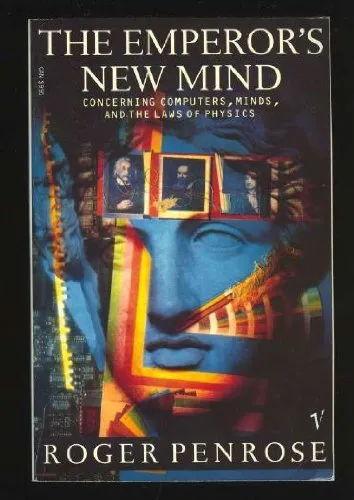
Book guide and evaluation
The Emperor's New Mind: Concerning Computers, Minds, and the Laws of Physics
Penrose
English
Beginner
Mathematical Logic
4.2 / 5
0 reviews
1994
Published
247
pages
590
views
Introduction Roger Penrose's "The Emperor's New Mind: Concerning Computers, Minds, and the Laws of Physics" is a profound exploration of consciousness, artificial intelligence, and the fundamental laws of physics. The book challenges the prevailing conception that human co
Before you read
What will you get from this book?
Introduction
Roger Penrose's "The Emperor's New Mind: Concerning Computers, Minds, and the Laws of Physics" is a profound exploration of consciousness, artificial intelligence, and the fundamental laws of physics. The book challenges the prevailing conception that human consciousness can be fully emulated by machines, presenting an intricate tapestry woven from threads of quantum mechanics, mathematics, and philosophy. Penrose, celebrated for his contributions to mathematics and physics, extends an invitation to ponder the deep questions surrounding the human mind and the capabilities of computers.
Detailed Summary of the Book
"The Emperor's New Mind" opens with an analysis of what intelligence and consciousness mean in the context of human experience. Penrose argues against the notion that computers, operating purely through algorithmic processes, can replicate the exact essence of human thought. He delves into artificial intelligence, examining what makes human cognition unique compared to mechanical computation.
A significant portion of the book is dedicated to exploring the implications of Gödel's incompleteness theorems, which suggest that there are truths in mathematics that cannot be proven by any algorithmic process. Penrose asserts that the human mind's ability to comprehend these truths indicates a non-computational element that cannot be replicated by machines.
The narrative intricately links the limits of computation to the fundamental laws of physics. Penrose introduces concepts from quantum mechanics and general relativity to propose that a new type of physics may hold the key to understanding consciousness. This groundbreaking idea notably suggests that consciousness may arise from quantum processes, a hypothesis that would require a major paradigm shift in both science and philosophy.
Key Takeaways
- Human consciousness may involve elements that go beyond algorithmic computation.
- Gödel’s incompleteness theorems highlight limitations in formal systems, including those used by computers.
- Quantum physics might provide insights into the nature of consciousness that classical computing cannot.
- The intersection of physics, mathematics, and philosophy is crucial in tackling the mysteries of the mind.
Famous Quotes from the Book
"Understanding is something different from knowing the correct algorithm."
"The world is a logical place, where any apparently strange phenomena have rational explanations."
Why This Book Matters
Roger Penrose's "The Emperor's New Mind" is a pivotal text that challenges conventional views in artificial intelligence and cognitive science. It seeks to draw attention to the unexplored frontiers where physics meets philosophy, providing fertile ground for new scientific theories. The book is particularly significant for its early proposition of the potential role of quantum mechanics in consciousness, an idea that has since gained traction among researchers across diverse disciplines.
By bridging intricate scientific concepts with philosophical inquiries about the nature of thought, Penrose's work serves as a critical resource for scholars, thinkers, and anyone interested in the perennial questions of what it means to be human. The arguments put forth in "The Emperor's New Mind" continue to stimulate discussion and research, reminding us of the profound mystery surrounding the human mind and its connection to the cosmos.
Ask this book
Your question is answered in the context of this title and author. Each answer uses 2 points.
Sign in to ask the book assistant.
Reader reviews
0 reviews, 4.2 average out of 5
No reviews yet
If you have read this book, help the next reader with your experience.
Write a review
Sign in to publish a review.
Reader questions and answers
Ask a focused question and learn from the community.
Sign in to ask or answer a question.
No questions yet
Be the first to ask a clear, useful question.
What to read next
Related references that continue this learning path.