
Book guide and evaluation
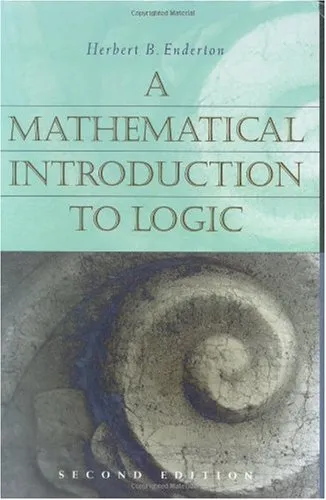
A mathematical introduction to logic
Herbert Enderton,Herbert B. Enderton
English
Beginner
Mathematical Logic
4.6 / 5
0 reviews
2001
Published
330
pages
626
views
Introduction to 'A Mathematical Introduction to Logic' 'A Mathematical Introduction to Logic' is a pivotal work that delves deeply into the structure of mathematical logic. Authored by Herbert Enderton, this book is designed to present both the fundamental principl
Before you read
What will you get from this book?
Introduction to 'A Mathematical Introduction to Logic'
'A Mathematical Introduction to Logic' is a pivotal work that delves deeply into the structure of mathematical logic. Authored by Herbert Enderton, this book is designed to present both the fundamental principles and the more intricate aspects of logic to students and enthusiasts of mathematics. Through rigorous exploration and a systematic approach, Enderton provides a comprehensive guide that balances theoretical concepts with practical applications. This book is ideal for those looking to expand their understanding of logical syntax, semantics, and the essential role logic plays in the realm of mathematics.
Detailed Summary of the Book
The book is structured to guide the reader from the basic elements of logic to more advanced topics. It begins with an exploration of propositional logic, setting the stage for an understanding of more complex structures. Enderton meticulously illustrates the use of tables, methods, and proofs to establish a foundational comprehension of logical statements and their interconnections.
Following this, the book delves into predicate logic, which is a more elaborate system of symbolic logic. The author explains different types of predicates, quantifiers, and the intricacies involved in building logical expressions. As one progresses through the text, it becomes clear how predicate logic extends the expressive power of mathematical language, allowing for a deeper grasp of logical arguments.
Furthermore, 'A Mathematical Introduction to Logic' covers topics such as set theory, model theory, and the completeness theorem, which are crucial for understanding more sophisticated logical frameworks. Notably, Enderton discusses Gödel's incompleteness theorems, drawing attention to the limits of formal systems and the philosophical implications these theorems entail.
Key Takeaways
- Logical frameworks are essential for the formulation and resolution of mathematical problems.
- Understanding both propositional and predicate logic is fundamental in analyzing logical expressions and constructing valid arguments.
- The exploration of advanced topics such as set theory and model theory enriches one's perspective on traditional and non-classical logics.
- Gödel's incompleteness theorems introduce significant philosophical discussions about the limitations of mathematical systems.
Famous Quotes from the Book
Logical consequence is at the heart of what logic is about. One set of sentences logically implies another set if any situation that makes all the sentences of the first set true also makes all the sentences of the second set true.
In mathematics, logic serves both as an object of study and a tool for other mathematical investigations.
Why This Book Matters
'A Mathematical Introduction to Logic' is an indispensable resource for anyone pursuing studies in mathematics or philosophy. By nurturing a robust comprehension of logic, readers can enhance their analytical thinking skills, facilitate problem-solving capabilities, and appreciate the structure underpinning mathematical theories. Enderton’s text is not just a mere introduction but a stepping stone to advanced logic courses and research, serving as a catalyst for ongoing intellectual curiosity in logic.
Additionally, the book's clear explanations and insightful examples make complex logical concepts accessible to newcomers while still challenging seasoned mathematicians. By addressing the limits of formal systems and discussing broader implications, the book encourages readers to reflect on the philosophical dimensions of logic.
Ask this book
Your question is answered in the context of this title and author. Each answer uses 2 points.
Sign in to ask the book assistant.
Reader reviews
0 reviews, 4.6 average out of 5
No reviews yet
If you have read this book, help the next reader with your experience.
Write a review
Sign in to publish a review.
Reader questions and answers
Ask a focused question and learn from the community.
Sign in to ask or answer a question.
No questions yet
Be the first to ask a clear, useful question.
What to read next
Related references that continue this learning path.
Advanced Theories and Computational Approaches to the Electronic Structure of Molecules
Thom. H. Dunning Jr.,Raymond A. Bair (auth.),Clifford E. Dykstra (eds.)
1984
View book
Novel Approaches to the Structure and Dynamics of Liquids: Experiments, Theories and Simulations
Sotiris S. Xantheas (auth.),Jannis Samios,Vladimir A. Durov (eds.)
2004
View book