
Book guide and evaluation
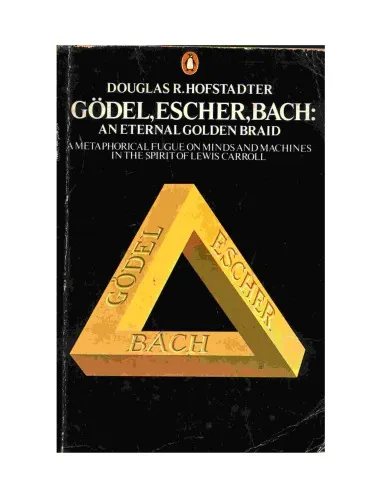
Gödel, Escher, Bach: An Eternal Golden Braid
Douglas R. Hofstadter
English
Beginner
Mathematical Logic
4.6 / 5
0 reviews
1994
Published
801
pages
619
views
Introduction to 'Gödel, Escher, Bach: An Eternal Golden Braid' Douglas R. Hofstadter's 'Gödel, Escher, Bach: An Eternal Golden Braid', often abbreviated as GEB, is a seminal work that seamlessly intertwines cognitive science, philosophy, mathematics, and art. This Pulitzer Pri
Before you read
What will you get from this book?
Introduction to 'Gödel, Escher, Bach: An Eternal Golden Braid'
Douglas R. Hofstadter's 'Gödel, Escher, Bach: An Eternal Golden Braid', often abbreviated as GEB, is a seminal work that seamlessly intertwines cognitive science, philosophy, mathematics, and art. This Pulitzer Prize-winning book explores the deep connections between the works of logician Kurt Gödel, artist M.C. Escher, and composer Johann Sebastian Bach, offering profound insights into how complex systems arise from simple rules.
Detailed Summary of the Book
At the heart of 'Gödel, Escher, Bach' is the idea of self-reference and its implications on the nature of human thought and consciousness. Hofstadter uses Gödel's Incompleteness Theorems as a starting point to delve into the intricate patterns and the concept of "strange loops" that recur in different forms across various disciplines. Each chapter alternates between dialogues featuring characters like Achilles and the Tortoise, exploring themes of logic and philosophy, and in-depth essays that investigate the interplay between Gödel's remarkable mathematical concepts, Escher's mind-bending artworks, and Bach's layered compositions.
The narrative unfolds in a manner that challenges readers to think about thinking itself, guiding them through a joyful exploration of how systems can contain themselves in a quest to achieve a deeper understanding of the mind's capacity for creative and recursive thought. Each thematic section cleverly builds upon the previous one, weaving a metaphorical golden braid that embodies unity through diversity, illustrating the interconnectedness of disparate elements in the pursuit of meaning.
Key Takeaways
- The concept of "strange loops" as self-referential systems is central to understanding consciousness.
- Interdisciplinary connections enhance our understanding of complex systems.
- Paradoxes and recursive structures reveal fundamental truths about logic and perception.
- Art and music serve as mirrors reflecting patterns observed in nature and mathematics.
- The relationship between formal systems and the essence of human cognition is deeply intertwined.
Famous Quotes from the Book
"The self is a mirage created by the brain’s strange loopiness."
"Gödel's fundamental discovery was that self-reference was not intrinsically evil, dangerous, or paradoxical, but could be used to create marvelous and fascinating new levels of understanding."
"The patterns and visions in Escher's work tantalize and intrigue precisely because they capture the very essence of what it means to be human."
Why This Book Matters
'Gödel, Escher, Bach: An Eternal Golden Braid' stands out as a cornerstone in the exploration of the mind and its numerous corridors of perception. Its interdisciplinary approach highlights the unity of all human knowledge, encouraging readers to see beyond the boundaries of individual disciplines. Hofstadter's work prompts a reevaluation of how artificial intelligence, mathematics, music, and art intersect, thus propelling discussions that remain relevant in today's world of rapid technological advancement. By dissecting the mechanisms of thought and creativity, GEB paves the way for profound conversations about what it means to be intelligent, humane, and conscious.
Ultimately, this book matters because it challenges us to embrace complexity and explore the symbiosis of disciplines that define our cultural and intellectual landscapes. Its legacy continues to inspire and provoke thought, making it a timeless resource for anyone with a passion for the rich tapestry of human knowledge.
Ask this book
Your question is answered in the context of this title and author. Each answer uses 2 points.
Sign in to ask the book assistant.
Reader reviews
0 reviews, 4.6 average out of 5
No reviews yet
If you have read this book, help the next reader with your experience.
Write a review
Sign in to publish a review.
Reader questions and answers
Ask a focused question and learn from the community.
Sign in to ask or answer a question.
No questions yet
Be the first to ask a clear, useful question.
What to read next
Related references that continue this learning path.
Proofs and Refutations: The Logic of Mathematical Discovery
Imre Lakatos,John Worrall,Elie Zahar
1976
View book
Advanced Theories and Computational Approaches to the Electronic Structure of Molecules
Thom. H. Dunning Jr.,Raymond A. Bair (auth.),Clifford E. Dykstra (eds.)
1984
View book