Book guide and evaluation
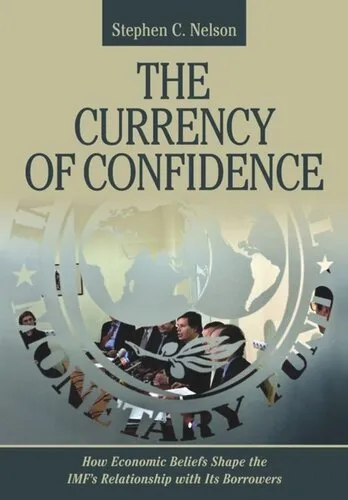
The Currency of Confidence: How Economic Beliefs Shape the IMF's Relationship with Its Borrowers
Stephen C. Nelson
English
Advanced
Art
4.3 / 5
0 reviews
2017
Published
246
pages
385
views
The Currency of Confidence: How Economic Beliefs Shape the IMF's Relationship with Its Borrowers International Monetary Fund policy analysis, economic ideologies in global governance The Currency of Confidence explores how economic beliefs shape the IMF's relationship w
Before you read
What will you get from this book?
Analytical Summary
In The Currency of Confidence: How Economic Beliefs Shape the IMF's Relationship with Its Borrowers, Stephen C. Nelson offers a rigorous and intellectually compelling exploration of the intersection between economic ideas and international financial diplomacy. This influential work examines how shared and contested beliefs about economic management influence the decisions, strategies, and relationships forged between the International Monetary Fund (IMF) and its borrowing countries.
Drawing from case studies, policy documents, and in-depth analysis, the book delves into the subtle yet powerful ways in which ideological alignment or divergence can facilitate or hinder cooperation between the IMF and sovereign governments. Nelson highlights that beyond the structural economic metrics, underlying economic philosophies—whether rooted in neoliberal orthodoxy, Keynesian interventionism, or other schools of thought—play a decisive role in shaping policy agreements and long-term outcomes.
This analytical narrative situates the IMF not simply as a technocratic institution, but as a political and ideological actor embedded in a complex network of global governance. By unpacking the relational dynamics, Nelson illuminates a crucial dimension often overlooked in traditional accounts of international monetary policy, offering readers fresh perspectives that blend political economy, economic sociology, and international relations scholarship.
Key Takeaways
Readers will come away with a deeper understanding of how economic beliefs—shared or contested—serve as a form of "currency" in global financial negotiations, profoundly influencing the IMF's effectiveness and legitimacy.
One key insight is that alignment in economic ideology between the IMF and borrower governments often leads to smoother negotiations and more sustained policy implementation. Conversely, ideological discord can exacerbate tensions, making agreements fragile or short-lived.
Another takeaway is Nelson's argument that the IMF’s role extends beyond economics into the realm of shaping and sustaining global economic discourse, affecting the confidence of markets, governments, and civil society alike.
Importantly, the book urges policymakers, scholars, and practitioners to consider the implicit beliefs and assumptions driving international financial decisions, opening new avenues for designing more equitable and effective policy frameworks.
Memorable Quotes
Economic confidence is as much a product of belief as it is of balance sheets.Unknown
Understanding the IMF means understanding the ideas that underpin its actions.Unknown
Global financial cooperation is sustained not solely by rules, but by shared convictions.Unknown
Why This Book Matters
The stakes of international financial governance are enormous, affecting economic stability and political sovereignty worldwide. Yet too often, discourse reduces these dynamics to technical calculations, ignoring the role of belief systems.
The Currency of Confidence: How Economic Beliefs Shape the IMF's Relationship with Its Borrowers matters because it bridges the gap between technical policy analysis and the ideological dimensions that animate global economic governance. Nelson’s critical perspective provides tools for recognizing, dissecting, and evaluating the assumptions silently embedded within economic policymaking.
Whether you are an academic researcher, a practitioner in global finance, or a policymaker seeking a more nuanced understanding of IMF operations, this book enriches your grasp of the dynamic interplay between confidence, belief, and financial policy.
Inspiring Conclusion
In a world where economic stability is constantly tested by shifting markets and evolving political landscapes, The Currency of Confidence: How Economic Beliefs Shape the IMF's Relationship with Its Borrowers offers an invaluable lens for understanding how trust and ideology shape outcomes in international finance.
Nelson’s work inspires readers to question the taken-for-granted assumptions underlying global economic governance and encourages a more reflective approach to IMF engagement. This book invites its audience to engage deeply: read it, share its insights, discuss them among peers, and apply its lessons to both academic inquiry and practical policymaking.
Ask this book
Your question is answered in the context of this title and author. Each answer uses 2 points.
Sign in to ask the book assistant.
Reader reviews
0 reviews, 4.3 average out of 5
No reviews yet
If you have read this book, help the next reader with your experience.
Write a review
Sign in to publish a review.
Reader questions and answers
Ask a focused question and learn from the community.
Sign in to ask or answer a question.
No questions yet
Be the first to ask a clear, useful question.
What to read next
Related references that continue this learning path.