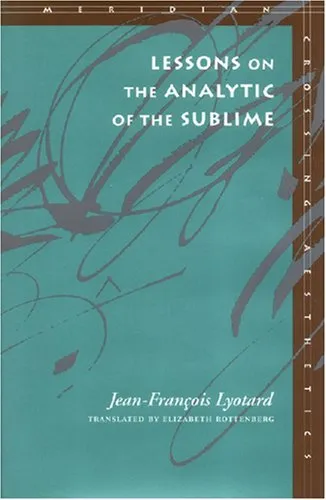
Lessons on the Analytic of the Sublime (Meridian: Crossing Aesthetics)
Jean-Francois Lyotard
1994
View book
Book guide and evaluation
Paul Guyer
0 reviews
Published
pages
views
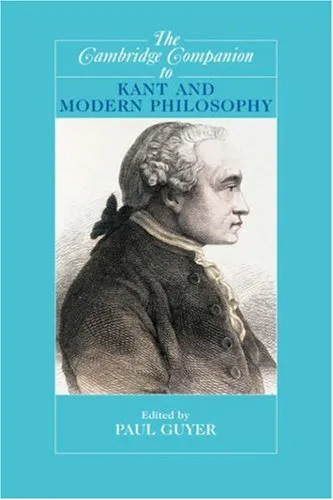
Introduction to 'The Cambridge Companion to Kant and Modern Philosophy' Immanuel Kant stands as a seminal figure in modern philosophy, whose influence extends across various philosophical domains, including metaphysics, epistemology, ethics, and aesthetics. 'The Ca
Before you read
Immanuel Kant stands as a seminal figure in modern philosophy, whose influence extends across various philosophical domains, including metaphysics, epistemology, ethics, and aesthetics. 'The Cambridge Companion to Kant and Modern Philosophy' offers a comprehensive exploration into the various dimensions of Kant's thought and its profound impact on modern philosophical discourse. This book is an essential guide for both students and scholars aiming to deepen their understanding of Kantian philosophy and its relevance to contemporary issues.
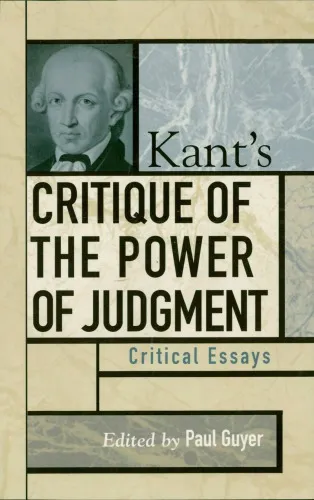
Edited by Paul Guyer, a leading Kant expert, this companion volume brings together a collection of essays from renowned scholars, each delving into different aspects of Kant's philosophy. The book is structured around central themes in Kant’s work, commencing with an examination of his historical context and intellectual background.
The opening chapters emphasize Kant's revolutionary ideas and his departure from previous philosophical traditions, setting the stage for his critical philosophy. Subsequent sections offer in-depth analyses of Kant’s three Critiques: the 'Critique of Pure Reason', the 'Critique of Practical Reason', and the 'Critique of the Power of Judgment'. Each chapter not only elucidates Kant’s original arguments but also considers their ongoing philosophical significance.
Beyond the Critiques, the companion explores Kant's theories on human nature, political philosophy, and religion, providing readers with a holistic view of his thought. The concluding essays address the reception of Kantian philosophy and its influence on later philosophical movements, such as German Idealism and Analytic Philosophy, highlighting Kant’s enduring legacy.
"Critique does not substitute experience in its place, but it establishes the possibility of metaphysical knowledge a priori."
"The understanding does not derive its laws (a priori) from, but prescribes them to, nature."
"Space and time are the two forms of sensible intuition, which are the pure forms of all the objects of intuition."
This companion serves as an invaluable resource for anyone seeking to navigate the complexities of Kant's thought. By assembling a diverse array of perspectives on Kant's work, the book not only enhances the reader’s understanding of his philosophical system but also illustrates its applicability and relevance to present-day philosophical challenges. As Kant’s ideas continue to influence contemporary debates in philosophy, this volume is crucial for grasping the foundation and evolution of modern philosophical thought.
Whether you are a student entering into the world of philosophy or an academic looking to deepen your appreciation of Kantian theory, 'The Cambridge Companion to Kant and Modern Philosophy' stands as a key text that bridges the past and present of philosophical inquiry.
Your question is answered in the context of this title and author. Each answer uses 2 points.
0 reviews, 4.6 average out of 5
Sign in to publish a review.
Ask a focused question and learn from the community.
Related references that continue this learning path.
Jean-Francois Lyotard