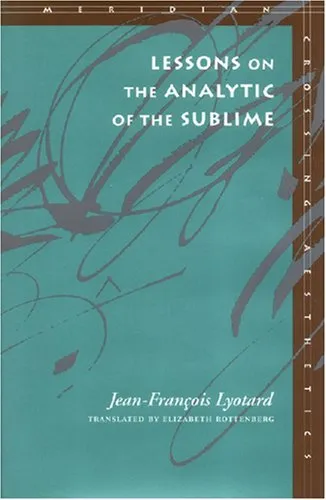
Lessons on the Analytic of the Sublime (Meridian: Crossing Aesthetics)
Jean-Francois Lyotard
1994
View book
Book guide and evaluation
Guyer,Paul
0 reviews
Published
pages
views
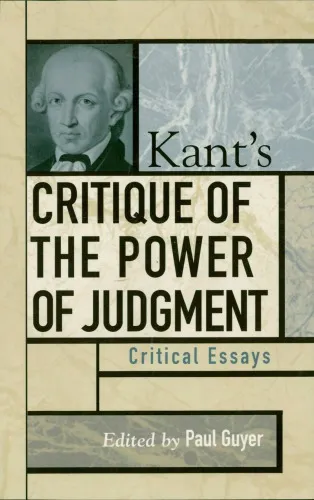
Introduction Welcome to an exploration of one of Immanuel Kant's seminal works, "The Critique of the Power of Judgment." This book serves as a critical collection of essays dedicated to unpacking the myriad complexities of Kant's philosophical masterpiece. Delv
Before you read
Welcome to an exploration of one of Immanuel Kant's seminal works, "The Critique of the Power of Judgment." This book serves as a critical collection of essays dedicated to unpacking the myriad complexities of Kant's philosophical masterpiece. Delve with us into the profound realms of aesthetics and teleology, where the power of judgment resides as a crucial mediator between understanding and reason.
Kant's "Critique of the Power of Judgment" demarcates a unique domain of inquiry—the judgment of taste and the teleological judgment. The book stands as the third Critique, following the Critique of Pure Reason and the Critique of Practical Reason. While the first Critique deals with our cognitive faculties and the second with the moral law, this Critique investigates the power of judgment and serves to bridge the gap between the sensibly conditioned and suprasensible ideas. Here, Kant examines subjective experiences, emphasizing aesthetics and teleological judgments, which provide the conditions for the possibility of unity within experience.
Central to this analysis is the notion of reflective judgment, which does not determine concepts from given objects but reflects upon them to discern an order or harmony. Kant posits that aesthetic judgment is subjective, yet necessary, and universal, raising questions about the beautiful and the sublime. Similarly, his inquiry into teleological judgment deals with how natural organisms and their perceived purposiveness impacts our understanding of nature's ultimate goals.
"The beautiful is that which is represented as an object of universal delight independent of any concept."
"Judgment in general is the faculty of thinking the particular as contained under the universal."
Kant's "Critique of the Power of Judgment" stands as a pivotal text in the Western philosophical tradition, representing a vital transition between Enlightenment reason and Romantic intuition. In bridging aesthetics and teleology, Kant presents a unique perspective on how the mind experiences the world, positing that beauty offers insight into the nature of the human experience and our pursuit of knowledge. This book is essential for understanding the depths of human creativity and the intrinsic link between our sensory experiences and moral judgments. By synthesizing concepts from the first two Critiques, this work forms a foundational cornerstone for any serious student of philosophy.
With its meticulous examination of aesthetic and teleological judgments, the book invites readers to engage critically with the complexities of Kant's philosophy, offering avenues for reinterpretation and discussion. It encourages a deeper appreciation for the interconnectedness of reason, beauty, and purpose, making it an invaluable resource for scholars, historians, and anyone interested in the continuing relevance of philosophical inquiry.
Your question is answered in the context of this title and author. Each answer uses 2 points.
0 reviews, 4.5 average out of 5
Sign in to publish a review.
Ask a focused question and learn from the community.
Related references that continue this learning path.
Jean-Francois Lyotard