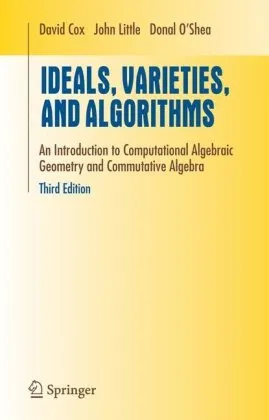
Ideals, varieties, and algorithms: an introduction to computational algebraic geometry and commutative algebra
David A. Cox,John Little,Donal O’Shea
2007
View book

Book guide and evaluation
Knuth D.E.
0 reviews
Published
pages
views
Welcome to the introduction of "The Art of Computer Programming, Volume 3: Sorting and Searching," an essential tome in the field of computer science, authored by renowned computer scientist Donald E. Knuth. This book has been a cornerstone for programmers
Before you read
Welcome to the introduction of "The Art of Computer Programming, Volume 3: Sorting and Searching," an essential tome in the field of computer science, authored by renowned computer scientist Donald E. Knuth. This book has been a cornerstone for programmers, computer scientists, and software engineers who are seeking to deepen their understanding of algorithm design, particularly focusing on sorting and searching techniques. The methodologies enclosed in this comprehensive volume have been guiding the development of efficient software since its publication, becoming indispensable for both academic study and practical problem-solving in professional environments.
Volume 3 delves into the complex yet fascinating world of sorting and searching algorithms. Knuth meticulously covers fundamental algorithms used to organize data efficiently, such as quicksort and mergesort, unraveling their intricate mechanisms with clarity and precision. The text is widely praised for its extensive research and mathematical rigor, epitomizing a meticulously crafted exploration of algorithm efficiency, correctness, and computational complexity. Each algorithm is dissected with rigorous mathematical analysis to provide a deeper understanding of the principles that guide their performance.
The volume also explores a myriad of searching algorithms, equipping readers with the necessary tools to locate data rapidly and effectively within vast datasets. With an emphasis on both comparison-based and non-comparison-based methods, readers gain insights into the efficiency and applicability of algorithms like binary search trees and hashing. The exploration of data structures like heaps and tries reinforces the importance of selecting the right tools to match the unique demands of diverse data environments.
"The process of choosing an algorithm is not a trivial task. It requires a deep understanding of both the data and the computational processes."
"Efficiency is not achieved through shortcuts; it is the result of a rigorous approach to understanding both the problem and the solution."
"The Art of Computer Programming, Volume 3" stands as a definitive guide in algorithmic study, significant for its richly detailed content and advanced approach to programming theory. Its influence is widespread, recognized universally as a foundational resource in computer science curriculum, and a valued guide for software professionals. The methodologies presented have been critical in shaping the modern understanding and development of efficient software systems.
Its importance extends beyond academia, influencing practical applications in diverse areas such as search engines, data management, and artificial intelligence. By mastering the concepts and techniques outlined in this volume, you contribute not only to your personal growth as a computer scientist or programmer but also advance the evolution of technology itself. In a world increasingly driven by data, having a robust understanding of sorting and searching algorithms, as provided by Knuth, is indispensable.
Persian Summary
Your question is answered in the context of this title and author. Each answer uses 2 points.
0 reviews, 4.4 average out of 5
Sign in to publish a review.
Ask a focused question and learn from the community.
Related references that continue this learning path.
David A. Cox,John Little,Donal O’Shea