Eventide Eclipse
2025/10/18
5 / 5
The introduction to Grobner basis is great. And if you want to learn deeply about it, Martin Kreuzer & Lorenzo Robbiano's book Computational Commutative Algebra 1 will be highly recommended.
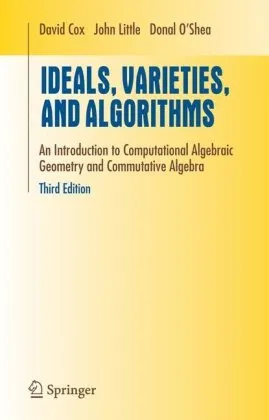
Book guide and evaluation
David A. Cox,John Little,Donal O’Shea
1 reviews
Published
pages
views
Introduction The book "Ideals, Varieties, and Algorithms: An Introduction to Computational Algebraic Geometry and Commutative Algebra" stands as a cornerstone in the fields of algebra and geometry, bridging computational techniques with theoretical constructs.
Before you read
The book "Ideals, Varieties, and Algorithms: An Introduction to Computational Algebraic Geometry and Commutative Algebra" stands as a cornerstone in the fields of algebra and geometry, bridging computational techniques with theoretical constructs. Authored by David A. Cox, John Little, and Donal O’Shea, it offers a comprehensive introduction to the essentials of computational algebraic geometry, with a strong focus on algorithmic aspects that appeal to both students and practitioners.
The book serves as an essential text that introduces the fundamental concepts of computational algebraic geometry and commutative algebra. It emphasizes the use of algorithms in solving polynomial equations and focuses on the connections between algebraic structures and geometric entities known as varieties. Each chapter builds upon the last, gradually increasing in complexity and depth while introducing concepts such as ideals, varieties, Groebner bases, and algorithms for polynomial systems.
An important theme throughout the book is the relationship between geometric intuition and algebraic proofs. The authors strategically blend theoretical discussions with practical algorithmic solutions, offering a balanced approach that makes the subject accessible to a wide audience. Numerous examples and exercises interspersed throughout the chapters help reinforce the material and give readers a chance to apply their knowledge in solving real-world problems.
"To study geometry is to delve into the very nature of space and shapes, guided by the precise language of algebra."
"Every ideal is like a corner of algebra where the shadow of infinity plays with the light of finite solutions."
"In the fabric of mathematics, algebra and geometry are the warp and weft, interwoven with logic and intuition."
"Ideals, Varieties, and Algorithms" is not just a textbook; it is a gateway into the world of mathematics where computational prowess meets abstract thought. This book matters because it demystifies complex concepts and provides a structured pathway to mastering an advanced topic with profound implications in both theoretical and applied mathematics. It has helped cultivate a deeper appreciation of how computational techniques can unlock new insights within the realm of algebraic geometry. For aspiring mathematicians, computer scientists, and engineers, this book is invaluable for developing both foundational understanding and practical skill sets.
The book is highly regarded for its clarity and pedagogical coherence. It has become a standard in classrooms around the world, praised for its ability to make an intricate topic comprehensible and engaging to students. By fostering an understanding of algebraic geometry's intersection with computation, this book encourages innovative thinking and problem-solving, integral to advancements in technology and science.
Your question is answered in the context of this title and author. Each answer uses 2 points.
1 reviews, 5.0 average out of 5
2025/10/18
5 / 5
The introduction to Grobner basis is great. And if you want to learn deeply about it, Martin Kreuzer & Lorenzo Robbiano's book Computational Commutative Algebra 1 will be highly recommended.
Sign in to publish a review.
Ask a focused question and learn from the community.
Related references that continue this learning path.

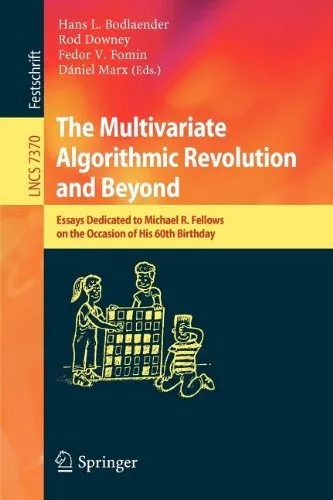
Michael A. Langston (auth.),Hans L. Bodlaender,Rod Downey,Fedor V. Fomin,Dániel Marx (eds.)