Book guide and evaluation
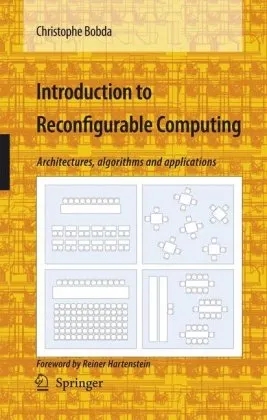
Introduction to Reconfigurable Computing: Architectures, Algorithms and Applications
Christophe Bobda
English
Beginner
Engineering
4.0 / 5
0 reviews
2007
Published
375
pages
627
views
Introduction to Reconfigurable Computing: Architectures, Algorithms and Applications Reconfigurable computing is a dynamic and rapidly evolving field that lies at the intersection of hardware design and computer science. This book, "Introduction to Reconfigurable Computing
Before you read
What will you get from this book?
Introduction to Reconfigurable Computing: Architectures, Algorithms and Applications
Reconfigurable computing is a dynamic and rapidly evolving field that lies at the intersection of hardware design and computer science. This book, "Introduction to Reconfigurable Computing: Architectures, Algorithms and Applications," provides a comprehensive overview of the technological and theoretical advancements in reconfigurable computing, offering readers the knowledge needed to engage with this fascinating subject.
Detailed Summary of the Book
This comprehensive guide delves into the versatile world of reconfigurable computing, covering fundamental designs, architectures, algorithms, and their myriad applications. As digital systems become increasingly intricate and the demand for customizable solutions escalates, reconfigurable computing provides the perfect platform for flexibility and efficiency—to harness such potential requires a nuanced understanding of various components within this evolving field.
Throughout the book, we unravel the mysteries of hardware specialization and computation. We begin our exploration by examining the essential architectures and circuit designs that underpin reconfigurable platforms, especially focusing on FPGAs (Field-Programmable Gate Arrays). Readers are guided through the intricacies of how these architectures can be tailored to specific computational tasks, offering significant improvements in speed and power consumption over traditional computing paradigms.
The book proceeds with a deep dive into programming models and languages specifically designed for reconfigurable computers, which simplify the process of mapping algorithms onto hardware. Through detailed examples and case studies, we explore how classical and modern algorithms can achieve optimal performance when executed on reconfigurable platforms.
The final portion of the book reveals the broad applications of reconfigurable computing in fields such as aerospace, bioinformatics, financial modeling, and beyond. By illuminating these applications, the book demonstrates how reconfigurability provides a competitive edge across different industries and research domains.
Key Takeaways
- Understanding reconfigurable computing's importance in contemporary digital systems and why it signifies a paradigm shift from traditional architectures.
- The capability to analyze and apply reconfigurable architectures to achieve performance efficiency and adaptability in computational tasks.
- Insight into the process of designing and implementing algorithms that leverage the strengths of reconfigurable platforms.
- Comprehension of the wide-ranging applications and potential of reconfigurable systems in solving complex real-world problems.
Famous Quotes from the Book
"In the realm of computing, adaptability is the key to survival; reconfigurable computing embodies this principle by allowing systems to evolve with changing requirements."
"The future of computing does not lie in more transistors but in the intelligent reconfiguration of existing resources."
Why This Book Matters
This book serves as a gateway for students, researchers, and professionals who aspire to grasp the full potential of reconfigurable computing. It breaks down complex concepts into readable segments, making it approachable for learners at all levels while still providing rich, technical depth for seasoned practitioners.
In a world where computational needs are perpetually evolving, the ability to fine-tune processors for specific applications provides unparalleled advantages. Reconfigurable computing is not just relevant but crucial to advancing computational efficiencies in diverse sectors of technology and industry. By understanding the principles detailed in this book, readers position themselves at the forefront of transformation within the computing landscape.
Ask this book
Your question is answered in the context of this title and author. Each answer uses 2 points.
Sign in to ask the book assistant.
Reader reviews
0 reviews, 4.0 average out of 5
No reviews yet
If you have read this book, help the next reader with your experience.
Write a review
Sign in to publish a review.
Reader questions and answers
Ask a focused question and learn from the community.
Sign in to ask or answer a question.
No questions yet
Be the first to ask a clear, useful question.
What to read next
Related references that continue this learning path.

The Multivariate Algorithmic Revolution and Beyond: Essays Dedicated to Michael R. Fellows on the Occasion of His 60th Birthday
Michael A. Langston (auth.),Hans L. Bodlaender,Rod Downey,Fedor V. Fomin,Dániel Marx (eds.)
2012
View book