

Operator Algebras and Quantum Statistical Mechanics 1: C*- and W*-Algebras Symmetry Groups Decomposition of States
Professor Ola Bratteli,Professor Derek W. Robinson (auth.)
1987
View book
Book guide and evaluation
Ugo Fano,A. R. P. Rau
0 reviews
Published
pages
views
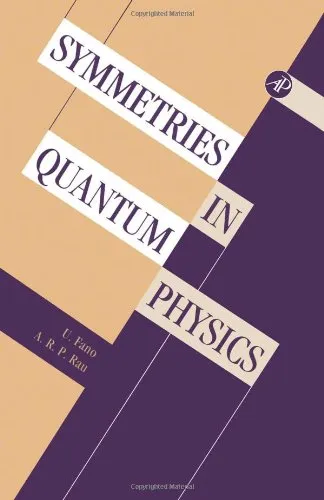
Introduction to "Symmetries in Quantum Physics" "Symmetries in Quantum Physics" offers an in-depth exploration of the profound and intricate role symmetry plays in the framework of quantum mechanics. Written by Ugo Fano and A. R. P. Rau, this groundbreaking work delves i
Before you read
"Symmetries in Quantum Physics" offers an in-depth exploration of the profound and intricate role symmetry plays in the framework of quantum mechanics. Written by Ugo Fano and A. R. P. Rau, this groundbreaking work delves into the mathematical and physical principles underpinning symmetry, providing insightful perspectives for students, researchers, and anyone captivated by the fundamental laws of physics.
The book emphasizes how symmetry is not merely a mathematical convenience but a cornerstone for understanding quantum phenomena. It begins with a fundamental introduction to symmetry concepts, offering clear explanations of topics such as group theory, invariance principles, and their applications in quantum mechanics. The authors meticulously guide readers through the technical scaffolding of tools like Lie groups and Lie algebras, showcasing how they illuminate the behavior of systems from atomic to subatomic scales.
Fano and Rau delve into the connections between symmetry and conservation laws, illustrating Emmy Noether’s theorem and its profound implications. The text builds upon these foundations to address symmetries in real-world systems, ranging from atomic structure to particle physics. Special attention is given to representations of symmetry in wavefunctions and operator formalism, highlighting key frameworks like rotations, spin, and parity transformations.
The book’s structure is a balance of rigor and accessibility. By blending mathematical formalism with physical intuition, the authors cater to a diverse audience, including physicists, applied mathematicians, and even philosophers interested in the epistemology of science. Moreover, they integrate historical anecdotes and practical examples that lend a humanizing dimension to the otherwise abstract discussions of symmetry in quantum systems.
"Symmetry is not just a tool but a lens through which the fabric of quantum mechanics is woven, revealing beauty and simplicity amidst complexity."
"In the quantum realm, it becomes evident that nature speaks the language of symmetry, with each particle and interaction governed by its dictates."
"Conservation laws serve as the fingerprints of symmetry, testifying to its pervasive presence across the physical universe."
"Symmetries in Quantum Physics" is more than just an academic text; it is a philosophical journey into the heart of quantum theory. The eloquence with which the authors unravel the tapestry of symmetry underscores its role as a unifying principle in physics. The book holds immense significance in educational and research contexts, providing a foundational resource for students learning quantum mechanics and professionals delving deeper into specialized fields like quantum field theory or mathematical physics.
Furthermore, the interdisciplinary appeal of the text ensures that it influences a wide spectrum of scientific inquiry. Whether discussing the role of symmetry in particle physics experiments or revealing its implications for emerging technologies like quantum computing, Fano and Rau demonstrate the enduring relevance of these concepts. In a rapidly evolving scientific landscape, the principles expounded in this book remain timeless, emphasizing the profound order that symmetry brings to our understanding of the quantum world.
Your question is answered in the context of this title and author. Each answer uses 2 points.
0 reviews, 4.5 average out of 5
Sign in to publish a review.
Ask a focused question and learn from the community.
Related references that continue this learning path.
Professor Ola Bratteli,Professor Derek W. Robinson (auth.)

D'Auria, Riccardo;Trigiante, Mario