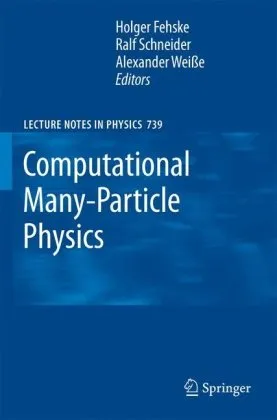
Computational Many-Particle Physics
Ralf Schneider,Amit Raj Sharma,Abha Rai (auth.),H. Fehske,R. Schneider,A. Weiße (eds.)
2008
View book

Book guide and evaluation
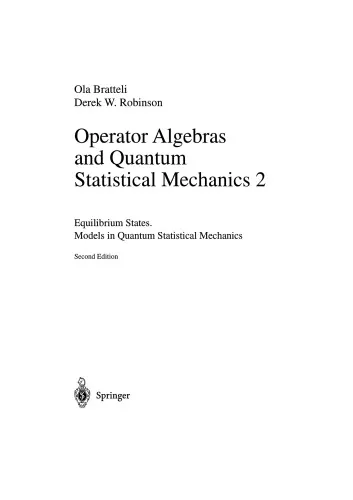
Professor Ola Bratteli,Professor Derek W. Robinson (auth.)
0 reviews
Published
pages
views
Introduction Welcome to 'Operator Algebras and Quantum Statistical Mechanics 1: C*- and W*-Algebras Symmetry Groups Decomposition of States,' a comprehensive exploration of the powerful interplay between operator algebras and quantum statistical mechanics. This book end
Before you read
Welcome to 'Operator Algebras and Quantum Statistical Mechanics 1: C*- and W*-Algebras Symmetry Groups Decomposition of States,' a comprehensive exploration of the powerful interplay between operator algebras and quantum statistical mechanics.
This book endeavors to bridge the concepts of mathematics and theoretical physics, providing a fundamental understanding of how operator algebras serve as a cornerstone in the formulation and interpretation of quantum mechanics and statistical physics. With an audience of graduate students, researchers, and professionals in both mathematics and physics, this book presents a rigorous examination of these concepts through the dual lenses of pure and applied mathematical frameworks.
This volume serves as an entry point to the study of operator algebras within the context of quantum statistical mechanics.
The narrative begins with a detailed introduction to the fundamental algebraic structures, primarily focused on C*-algebras and W*-algebras. The exploration continues with an examination of their symmetries and the role these symmetries play in the decomposition of states. Special emphasis is placed on the representation theory of these algebras and the impact of symmetry groups, such as automorphism groups, on these representations.
In addition to algebraic structures, the book delves into the intricate relationship between operator algebras and quantum statistical mechanics—focusing on the translation of physical phenomena into mathematical language. By doing so, it illustrates how these mathematical structures can be used to model complex systems and physical theories.
Throughout, various theorems and lemmas are discussed and proved, providing the reader with a firm mathematical foundation. Each chapter concludes with exercises and problems that encourage the reader to apply their understanding and deepen their conceptual grasp.
"Operator algebras offer a robust algebraic framework that captures the essence of quantum mechanical sysmmetries and statistical correlations."
"The unification of algebraic approaches with quantum theories unveils elegant solutions to longstanding theoretical puzzles."
This book is more than a textbook; it is a bridge linking the abstract world of mathematics with the palpable realities of quantum physics.
The text stands out as a seminal work in the field for its clarity in exposition and depth in content, helping readers from diverse backgrounds gain access to advanced topics in operator algebra and their applications in quantum statistical mechanics. By demystifying complex mathematical constructs through intuitive explanations and practical examples, the book fosters a deeper appreciation and understanding of the interconnectedness of mathematics and physics.
Moreover, the book's contribution to academic discourse lays a foundation for ongoing research in both disciplines, supporting the development of more sophisticated models and theories that continue to push the boundaries of what is known in quantum physics and mathematical analysis.
Your question is answered in the context of this title and author. Each answer uses 2 points.
0 reviews, 4.5 average out of 5
Sign in to publish a review.
Ask a focused question and learn from the community.
Related references that continue this learning path.
Ralf Schneider,Amit Raj Sharma,Abha Rai (auth.),H. Fehske,R. Schneider,A. Weiße (eds.)
![Cover of Quantum physics of atoms, molecules, solids, nuclei, and particles [SOLUTIONS]](https://s3.refhub.ir/images/thumb/Quantum_physics_of_atoms__molecules__solids___16894.webp)
Robert Martin Eisberg;Robert Resnick