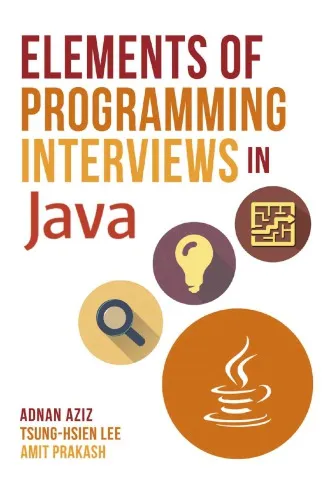
Elements of Programming Interviews in Java: The Insiders’ Guide
Adnan Aziz,Tsung-Hsien Lee,Amit Prakash
2016
View book
Book guide and evaluation
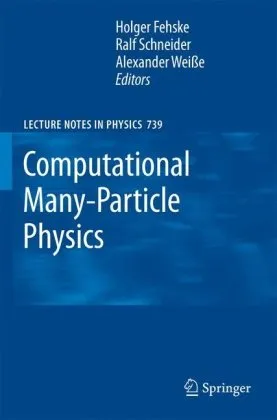
Ralf Schneider,Amit Raj Sharma,Abha Rai (auth.),H. Fehske,R. Schneider,A. Weiße (eds.)
0 reviews
Published
pages
views
Introduction Welcome to the captivating world of "Computational Many-Particle Physics," a remarkable work that pushes the boundaries of theoretical and computational physics. This book stands as a cornerstone for those striving to understand and simulate the comple
Before you read
Welcome to the captivating world of "Computational Many-Particle Physics," a remarkable work that pushes the boundaries of theoretical and computational physics. This book stands as a cornerstone for those striving to understand and simulate the complex interactions of many particles. It presents a systematic approach to computational methods and their applications in modern physics. A perfect blend of theory, method, and implementation, it delves deeply into the world of many-particle systems, providing both comprehensive insights and practical tools.
"Computational Many-Particle Physics" delivers a profound exploration of many-particle systems using computational methods. The content is designed to cater to both novices and seasoned researchers in the field of computational physics. It starts with fundamental numerical techniques and progresses into advanced algorithms and their application in physical systems.
One of the book's highlights is its emphasis on real-world applications. It meticulously explains how computational techniques can be used to solve practical problems in areas such as condensed matter physics, quantum chemistry, and material science. Through detailed derivations, pseudocode, and real-world examples, the reader learns how to simulate and interpret phenomena at the atomic and molecular levels.
The book contains a wealth of information on algorithms for simulating large-scale systems, making it an invaluable resource for those working with complex physical models. From Monte Carlo methods to quantum statistical mechanics, each topic is handled with precision, balanced with theoretical and computational challenges.
The reader will find several key takeaways in this book:
Here are some profound insights taken directly from the pages of the book:
"The pursuit of exact solutions in many-particle systems is often less about reaching a final destination, but rather about understanding the intricate journey and the interactions encountered along the way."
"In the realm of computational physics, the algorithms are not merely a tool but a language—a medium through which we converse with the abstract realms of many-particle systems."
The field of many-particle physics is inherently complex, with interactions occurring on scales that challenge the limits of classical computing. "Computational Many-Particle Physics" bridges the gap between abstract theoretical models and the computational power needed to explore them. Its importance lies in providing the detailed methodologies and the underlying physics principles necessary for tackling real-world scientific problems.
By equipping readers with both foundational knowledge and cutting-edge techniques, the book serves as an indispensable guide for educators, researchers, and professionals in the domain of physics and computational science. Its approach ensures that readers not only learn the technicalities of computational methods but also appreciate how these methods illuminate the understanding of physical phenomena.
By embracing both classical and quantum perspectives, this book prepares readers to contribute to innovative research in fields ranging from quantum mechanics to nanotechnology.
In a world increasingly reliant on computational simulations for predictive and exploratory work in science and technology, "Computational Many-Particle Physics" stands as an essential resource.
Your question is answered in the context of this title and author. Each answer uses 2 points.
0 reviews, 5.0 average out of 5
Sign in to publish a review.
Ask a focused question and learn from the community.
Related references that continue this learning path.
Adnan Aziz,Tsung-Hsien Lee,Amit Prakash
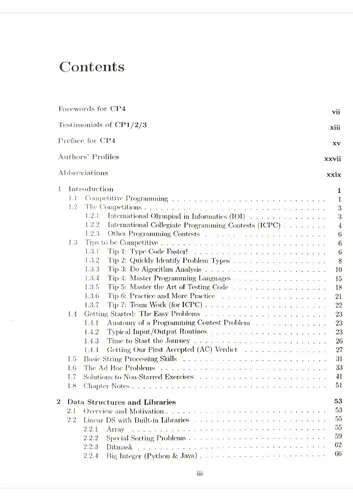
Steven Halim,Felix Halim,Suhendry Effendy