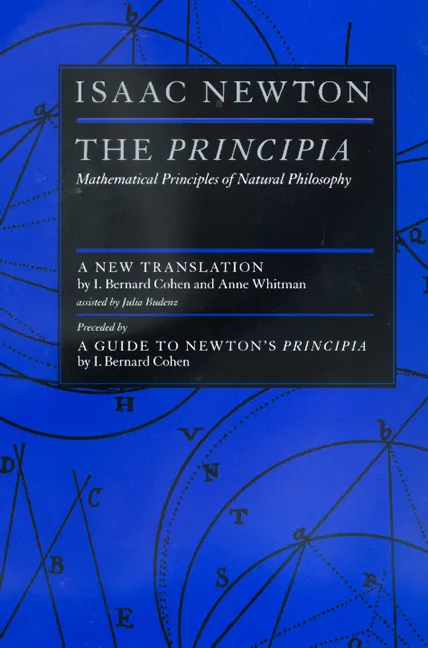
The Principia: Mathematical Principles of Natural Philosophy
Isaac Newton,I. Bernard Cohen,Anne Whitman,Julia Budenz
1999
View book
Book guide and evaluation
Kurt Sundermeyer (auth.)
0 reviews
Published
pages
views
Welcome to the book Symmetries in Fundamental Physics! This work is designed to provide readers with deep insights into the profound role symmetry plays in the foundation of modern physics. Symmetry—a concept that combines mathematical elegance with physical meaning—lies at
Before you read
Welcome to the book Symmetries in Fundamental Physics! This work is designed to provide readers with deep insights into the profound role symmetry plays in the foundation of modern physics. Symmetry—a concept that combines mathematical elegance with physical meaning—lies at the heart of some of the greatest scientific achievements of the last century. This book captures the essence of symmetry as a guiding principle in understanding the universe, helping both students and researchers to grasp the profound connections between abstract symmetries and real-world phenomena.
In the first chapter, we explore the origins and philosophical implications of symmetry in physics, beginning with its profound role in classical mechanics and moving toward its impact in quantum theory. The book methodically introduces the reader to the mathematical tools of symmetry analysis, including group theory, Lie algebras, and transformation principles. Starting with familiar systems in physics, such as simple harmonic motion and rotational invariance, the narrative gradually transitions into more advanced topics like gauge symmetries, Noether's theorem, and particle physics.
One of the cornerstones of this work is the exploration of symmetry breaking, a process crucial in the formation of complex structures and fundamental in explaining phenomena such as the Higgs mechanism and phase transitions. Detailed discussions include the role of discrete and continuous symmetries in electroweak unification, the significance of conserved quantities, and applications in quantum field theories.
Throughout the book, each concept is backed by rigorous mathematical formalism and rich physical examples, making it both intellectually satisfying and practically valuable. The final chapters emphasize the modern challenges regarding symmetry in advanced topics, such as supersymmetry (SUSY), string theory, and beyond the Standard Model theories. The text is structured to be accessible while maintaining scientific rigor, offering an invaluable resource for physicists and mathematicians alike.
"Symmetry is not merely a mathematical artifact; it is the compass guiding us through the complexities of the physical universe, offering clarity where chaos seems to reign."
"The breaking of symmetry—so paradoxical at first glance—is the key to understanding how simplicity gives rise to complexity in the cosmos."
"Physics progresses not by accumulating isolated facts, but by uncovering the fundamental symmetries that govern reality."
The importance of Symmetries in Fundamental Physics cannot be overstated in today's scientific landscape. Symmetry is a concept that bridges the abstract beauty of mathematics with the tangible realities of the physical world. By delving into this book, readers gain an appreciation for how symmetry forms the backbone of our best theories, providing a consistent framework to describe nature's underlying patterns.
Whether you are a physicist seeking a stronger grasp of modern theories or a student looking for a comprehensive introduction to the subject, this book offers a balanced mix of historical context, theoretical frameworks, and practical applications. The inclusion of recent developments and open problems ensures that the reader stays at the frontier of physics research. Above all, the book demonstrates that symmetry is not just a tool for solving equations; it is a profound idea that unites science and art, inspiring humanity's quest to understand the universe.
Your question is answered in the context of this title and author. Each answer uses 2 points.
0 reviews, 4.5 average out of 5
Sign in to publish a review.
Ask a focused question and learn from the community.
Related references that continue this learning path.
Isaac Newton,I. Bernard Cohen,Anne Whitman,Julia Budenz
![Cover of The Feynman Lectures on Physics [Vol 1]](https://s3.refhub.ir/images/thumb/The_Feynman_Lectures_on_Physics__Vol_1_15281.webp)