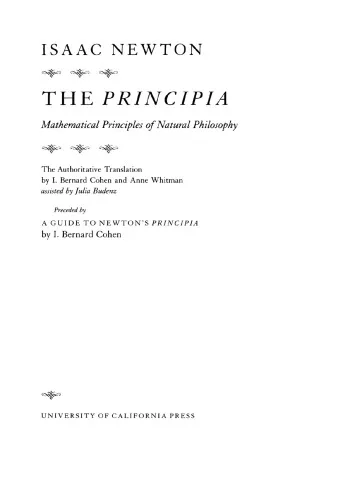
The Principia: Mathematical Principles of Natural Philosophy
Isaac Newton,I. Bernard Cohen,Anne Whitman,Julia Budenz
1999
View book
Book guide and evaluation
Isaac Newton (editor);Florian Cajori (editor);Andrew Motte (editor)
0 reviews
Published
pages
views
Introduction to Sir Isaac Newton’s Mathematical Principles of Natural Philosophy and His System of the World Isaac Newton’s Mathematical Principles of Natural Philosophy, commonly referred to as the Principia, is one of the most influential works in human thought and marks a
Before you read
Isaac Newton’s Mathematical Principles of Natural Philosophy, commonly referred to as the Principia, is one of the most influential works in human thought and marks a monumental shift in our understanding of the natural world. First published in 1687, this groundbreaking text laid the foundation for classical mechanics, providing a comprehensive framework that explained both terrestrial and celestial phenomena. Newton's work united mathematics, physics, and astronomy into a cohesive system that has shaped modern science and technology. In this book, Newton encapsulates the laws of motion, universal gravitation, and the mathematical principles that govern the physical reality around us.
In addition to its scientific innovations, the Principia represents a remarkable intellectual achievement—even centuries after its publication. With the accompanying section The System of the World, Newton extends his mathematical principles to explain the motion of celestial bodies, giving rise to a deeper understanding of planetary motion that would profoundly impact observational astronomy, engineering, and navigation.
This annotated and translated version, meticulously edited by Andrew Motte in its 1729 English translation and later revised by mathematician Florian Cajori, ensures that the brilliance of Newton's insights is accessible to a wider audience. Below, we delve deeper into the contents of the book, its significance, and its continued relevance in the world today.
Newton’s Principia is divided into three major books, each addressing a crucial aspect of natural philosophy:
Throughout the text, Newton employs mathematical rigor to unify seemingly disparate phenomena, reinforcing the idea of a natural, predictable order in the universe.
Newton’s Principia offers several profound lessons that transcend its original scientific context:
While Newton’s writing is primarily mathematical, several passages provide insight into the philosophy underpinning his work:
The Principia not only revolutionized science but also laid the groundwork for many technological advancements we enjoy today. By elucidating principles of motion and gravitation, Newton provided tools that enabled the development of disciplines such as engineering, aerospace science, and modern physics.
Beyond its scientific impact, the book exemplifies the power of intellectual inquiry and meticulous reasoning. Its influence extends to philosophy, as Newton’s work inspired Enlightenment thinkers who applied the principles of reason and evidence to realms beyond science.
Ultimately, Mathematical Principles of Natural Philosophy is much more than a scientific text—it is a masterpiece that embodies the human quest for knowledge and our enduring desire to understand the universe.
In opening this timeless work, the reader steps into the mind of one of history’s greatest thinkers, embarking on a journey to uncover the fundamental truths that shape our world and beyond.
Your question is answered in the context of this title and author. Each answer uses 2 points.
0 reviews, 4.6 average out of 5
Sign in to publish a review.
Ask a focused question and learn from the community.
Related references that continue this learning path.
Isaac Newton,I. Bernard Cohen,Anne Whitman,Julia Budenz
Isaac Newton;Bernard Cohen, Anne Whitman (trans.)