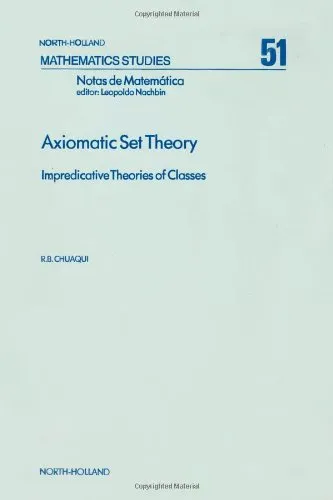
Axiomatic Set Theory: Theory Impredicative Theories of Classes
Leopoldo Nachbin (Eds.)
1981
View book
Book guide and evaluation
Irving Kaplansky
0 reviews
Published
pages
views
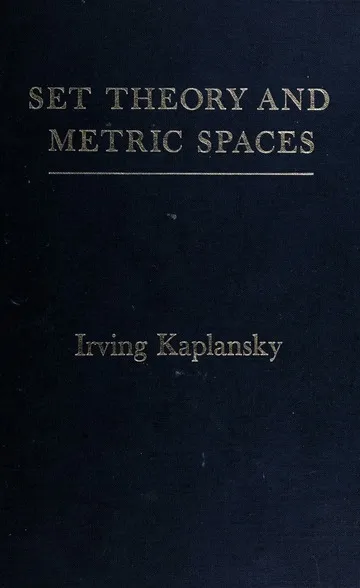
Introduction to "Set Theory and Metric Spaces" "Set Theory and Metric Spaces" by Irving Kaplansky is a masterful exploration of two pivotal mathematical areas that underpin much of modern mathematics. Written with clarity and precision, this book serves as both an introd
Before you read
"Set Theory and Metric Spaces" by Irving Kaplansky is a masterful exploration of two pivotal mathematical areas that underpin much of modern mathematics. Written with clarity and precision, this book serves as both an introduction and a deeper dive into the nuanced concepts of set theory and metric spaces. Designed for students, mathematicians, and enthusiasts of abstract mathematics, the text bridges the gap between fundamental theory and practical application, making it an invaluable resource for learners and professionals alike.
Mathematics often requires a strong foundational understanding of abstract theories, and set theory forms the bedrock upon which much of modern mathematical thought is built. Similarly, metric spaces, characterized by their study of distance and structure, are crucial to areas like topology, analysis, and geometry. In this book, Kaplansky crafts a concise yet comprehensive narrative that introduces these essential topics with rigor, while ensuring accessibility for readers at various stages of their mathematical journeys.
The book is divided into two primary sections: set theory and metric spaces. Each section is thoughtfully structured to gradually build a reader’s understanding through rigorous definitions, theorems, examples, and proofs.
The set theory portion covers foundational concepts such as sets, relations, functions, and cardinality. Readers are introduced to basic operations on sets, including unions, intersections, and complements, as well as key properties of set inclusion. Building on these, the book delves into infinite sets and their cardinality, introducing ideas like countability and uncountability, inspired by the work of Cantor.
In the section on metric spaces, a structured approach introduces fundamental ideas like open and closed sets, convergence of sequences, and continuity of functions within the context of metric spaces. These concepts are pivotal for understanding more advanced topics in analysis and topology. Additionally, the book explores the topological properties of metric spaces and emphasizes compactness and completeness—concepts central to functional analysis and related fields.
Kaplansky’s approach is both systematic and engaging. Each new topic builds upon the last, allowing the reader to see the interconnectedness of these two areas in the broader landscape of mathematics.
"Mathematics is a quest for certainty, and in set theory, this quest begins with the simplest of objects—a set."
"The study of metric spaces reminds us that distance, though intuitive, can take many abstract forms."
"Set Theory and Metric Spaces" is more than just a textbook; it is a gateway to the world of modern mathematics. The clarity of exposition and depth of insight make it a seminal work for anyone looking to build a strong foundation in mathematical logic and abstraction. By comprehensively addressing the key tenets of set theory and metric spaces, Kaplansky enables readers not only to understand mathematics on a theoretical level but also to apply these concepts in various domains, including analysis, geometry, and computer science.
For students and self-learners, this book offers a solid framework for mastering abstract mathematics. For educators, it is a trusted reference work that supports teaching advanced topics with clarity and coherence. And for professionals in related fields, it provides a grounding in two areas that frequently arise in research and problem-solving. Irving Kaplansky’s work stands as a testament to the beauty and power inherent in mathematical thought, making it a timeless resource for generations to come.
Your question is answered in the context of this title and author. Each answer uses 2 points.
0 reviews, 4.5 average out of 5
Sign in to publish a review.
Ask a focused question and learn from the community.
Related references that continue this learning path.
Leopoldo Nachbin (Eds.)