Book guide and evaluation
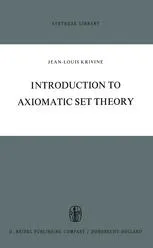
Introduction to Axiomatic Set Theory
Jean-Louis Krivine (auth.)
English
Beginner
Set Theory
4.4 / 5
0 reviews
1971
Published
107
pages
514
views
Detailed Summary of the Book Understanding the structural foundation of mathematics is both an alluring and challenging pursuit. "Introduction to Axiomatic Set Theory" by Jean-Louis Krivine serves as a comprehensive guide through the captivating world of set theory, one of
Before you read
What will you get from this book?
Detailed Summary of the Book
Understanding the structural foundation of mathematics is both an alluring and challenging pursuit. "Introduction to Axiomatic Set Theory" by Jean-Louis Krivine serves as a comprehensive guide through the captivating world of set theory, one of the core areas in mathematical logic.
The book begins with the basic concepts of set theory, introducing readers to the nuanced language and symbolic expressions inherent in mathematical discourse. Krivine meticulously delineates topics such as sets, relations, and functions while building towards the more complex axiomatic system of set theory. It progressively covers fundamental axioms including the Axiom of Extensionality, Axiom of Regularity, Axiom of Choice, and Zermelo-Fraenkel axioms, ensuring a solid understanding of their underlying logic and practical significance.
As the narrative progresses, readers are engaged with discussions on ordinal and cardinal numbers, infinite sets, and models of set theory such as Gödel constructible universe. By interweaving proofs with conceptual discussions, Krivine offers insight not only into the mechanics of set theoretic operations but also into their philosophical implications.
Key Takeaways
- A comprehensive overview of axiomatic set theory guided by an experienced mathematician.
- Core concepts include fundamental axioms and their applications, ensuring a robust mathematical foundation.
- Explorations of cardinal and ordinal numbers provide vital tools for reasoning about infinite structures.
- Through the constructible universe, readers encounter Gödel’s groundbreaking work and the Continuum Hypothesis.
- The book balances rigorous proofs with discussions, making it a useful resource for learners and instructors alike.
Famous Quotes from the Book
"In the domain of mathematics, understanding begins only at the point where we recognize the limits of our intuition."
"Axioms are not self-evident truths but rather chosen constructs through which we order and explore the infinite landscape of sets."
Why This Book Matters
"Introduction to Axiomatic Set Theory" holds profound importance not just for students of mathematics, but for anyone engaged with logical reasoning and the foundations of mathematics. Axiomatic set theory serves as the underpinning of virtually all mathematical disciplines, providing the logical framework upon which the structure of mathematics is built. Understanding these axioms and their applications can broaden one’s comprehension of mathematical theories and their implications in the real world.
The clarity and precision with which Krivine addresses complex topics render this book an invaluable resource for educators, researchers, and students alike. It bridges the gap between abstract theoretical concepts and practical understanding, persuading readers to ponder the depths of mathematical constructs and their axiomatic roots. Krivine’s work is both a testament to the elegance of mathematical logic and a tool for demystifying its complexities, encouraging deep critical thinking and exploration in the realm of mathematics.
Ask this book
Your question is answered in the context of this title and author. Each answer uses 2 points.
Sign in to ask the book assistant.
Reader reviews
0 reviews, 4.4 average out of 5
No reviews yet
If you have read this book, help the next reader with your experience.
Write a review
Sign in to publish a review.
Reader questions and answers
Ask a focused question and learn from the community.
Sign in to ask or answer a question.
No questions yet
Be the first to ask a clear, useful question.
What to read next
Related references that continue this learning path.
Axiomatic Set Theory: Theory Impredicative Theories of Classes
Leopoldo Nachbin (Eds.)
1981
View book