Book guide and evaluation
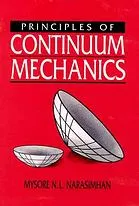
Principles of continuum mechanics
Mysore N L Narasimhan
English
Beginner
Applied Mathematics
4.8 / 5
0 reviews
1993
Published
580
pages
388
views
Introduction to the Book "Principles of Continuum Mechanics" is a comprehensive guide designed to provide readers with an in-depth understanding of the fundamental principles governing the behavior of materials and systems in the continuum framework. Written with clarity a
Before you read
What will you get from this book?
Introduction to the Book
"Principles of Continuum Mechanics" is a comprehensive guide designed to provide readers with an in-depth understanding of the fundamental principles governing the behavior of materials and systems in the continuum framework. Written with clarity and precision, this book serves as an essential resource for engineers, physicists, and applied mathematicians alike, facilitating a seamless transition from theory to practical application. Covering a broad range of topics, from the mathematical foundations of continuum mechanics to problem-solving approaches, the book ensures readers develop a profound grasp of both analytical techniques and conceptual frameworks.
At its core, this book takes a rigorous yet accessible approach to unraveling the complexities of continuum mechanics. By integrating real-world examples, step-by-step explanations, and problem-solving exercises, it appeals not only to students beginning their journey in the field but also to experienced professionals looking to deepen their expertise. With a focus on clarity and logical progression of concepts, "Principles of Continuum Mechanics" provides a solid foundation for understanding the behavior of materials in different physical states, including solids, fluids, and gases.
Detailed Summary of the Book
The book begins with an overview of the mathematical tools and conventions needed to study continuum mechanics. Readers are introduced to essential concepts such as vectors, tensors, and differential equations, which form the backbone of the subject. Once equipped with the foundational mathematical framework, the book delves into the physical principles defining continuum mechanics, including the conservation laws of mass, momentum, and energy.
Subsequently, an in-depth discussion on the kinematics of deformation and motion is provided. This helps readers understand how materials deform or flow under external forces. Next, the book explores the formulation of constitutive equations, offering detailed insights into how various materials respond to stress and strain. Solid mechanics, fluid mechanics, and thermodynamic principles are seamlessly integrated throughout, providing a holistic view of the subject.
The final chapters emphasize advanced topics such as nonlinear behavior, computational approaches, and dynamic systems. A significant focus is placed on applying continuum mechanics principles to solve practical engineering problems. Detailed examples across fields such as aerospace, biomechanics, and structural engineering help reinforce theoretical explanations, enabling readers to grasp the utility of the concepts.
Key Takeaways
- Thorough understanding of the mathematical foundations of continuum mechanics.
- Development of problem-solving skills to analyze real-world systems and materials.
- Insight into the physical significance of conservation laws and constitutive equations.
- Application of continuum mechanics principles to interdisciplinary challenges in science and engineering.
- Mastery of techniques used in modeling complex dynamic and nonlinear systems.
Famous Quotes from the Book
"To understand the continuum is to understand the interconnectivity of the physical world; no particle exists in isolation, and every motion resonates through the material."
"Mathematics provides the language, and physics provides the meaning—together they offer clarity to the seemingly chaotic behavior of materials."
Why This Book Matters
"Principles of Continuum Mechanics" is not just a textbook—it is a bridge between abstract theory and practical engineering, making it uniquely valuable in today's academic and industrial landscape. By establishing a strong foundational understanding of the subject, the book empowers readers to tackle complex challenges in diverse fields such as mechanical engineering, materials science, biomechanics, and beyond.
In a world where material innovation drives technological progress, understanding continuum mechanics has become increasingly vital. This book equips readers with the tools to model, analyze, and predict the behavior of various materials under diverse conditions, fostering innovation and enhancing design capabilities. Whether you're an academic, a professional engineer, or a student, "Principles of Continuum Mechanics" will inspire you to think critically, solve problems holistically, and contribute meaningfully to your field.
Ask this book
Your question is answered in the context of this title and author. Each answer uses 2 points.
Sign in to ask the book assistant.
Reader reviews
0 reviews, 4.8 average out of 5
No reviews yet
If you have read this book, help the next reader with your experience.
Write a review
Sign in to publish a review.
Reader questions and answers
Ask a focused question and learn from the community.
Sign in to ask or answer a question.
No questions yet
Be the first to ask a clear, useful question.
What to read next
Related references that continue this learning path.
Data-Driven Science and Engineering: Machine Learning, Dynamical Systems, and Control
Steven L. Brunton,J. Nathan Kutz
2019
View book