

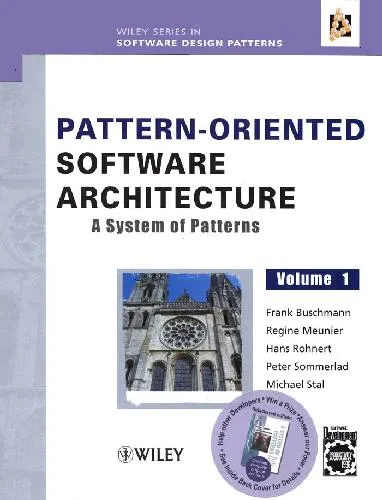
Book guide and evaluation
Pattern-Oriented Software Architecture, Volume 1: A System of Patterns
Buschmann F.,Rohnert H.,Sommerlad P.
English
Advanced
Software Architecture
4.0 / 5
0 reviews
1996
Published
487
pages
720
views
Pattern-Oriented Software Architecture, Volume 1: A System of Patterns Introduction In the ever-evolving realm of software architecture, the journey to master the art and science of designing robust and scalable systems can be daunting. Recognizing the significance of r
Before you read
What will you get from this book?
Pattern-Oriented Software Architecture, Volume 1: A System of Patterns
Introduction
In the ever-evolving realm of software architecture, the journey to master the art and science of designing robust and scalable systems can be daunting. Recognizing the significance of reusable design solutions, Pattern-Oriented Software Architecture, Volume 1: A System of Patterns serves as an essential guide for both budding and seasoned architects. This seminal book explores the concept of design patterns through a well-structured exposition, providing architects and developers with the tools they need to create adaptable and efficient software systems.
Detailed Summary of the Book
This volume introduces readers to the effective use of design patterns in software architecture. It provides a comprehensive catalog of architectural patterns, detailing more than twenty patterns that are crucial for solving recurring software design problems. The book is meticulously organized to offer both a theoretical understanding and practical applications of these patterns. The authors delve into each pattern's structure, functionality, and usage, providing careful analysis and real-world examples to illustrate their impact and relevance in building maintainable and scalable software systems.
Structured to cater to a diverse audience, from software architects to system analysts, this book challenges and enriches the reader's understanding of software development. It equally emphasizes the patterns' context, problem domains, and the consequences of their application, ensuring readers appreciate not only the 'how' but also the 'why' of using patterns.
Key Takeaways
- Insight into over twenty foundational architectural patterns.
- Detailed exploration of pattern context, forces, solutions, and consequences.
- Enhanced understanding of pattern interactions and pattern languages.
- Ability to identify and apply patterns to address common design challenges.
- Appreciation of design patterns as a craft to improve both individual and team proficiency in software architecture.
Famous Quotes from the Book
“Design patterns are a shared language for software development.”
“The elegance of a pattern lies in its ability to balance conflicting forces effectively in a given context.”
Why This Book Matters
The tech industry is synonymous with perpetual change and innovation. In such a fluid environment, building software that is both scalable and maintainable becomes imperative. This book matters because it empowers practitioners by equipping them with a language and framework to navigate complex design landscapes.
By focusing on design patterns, the book helps demystify the process of creating architectures that are robust and flexible. Moreover, it facilitates more effective collaboration among development teams by promoting a shared understanding of design solutions. It sets a precedent for excellence in software architecture, ensuring that systems are not only functional from the outset but also adaptable to future changes and needs.
Ask this book
Your question is answered in the context of this title and author. Each answer uses 2 points.
Sign in to ask the book assistant.
Reader reviews
0 reviews, 4.0 average out of 5
No reviews yet
If you have read this book, help the next reader with your experience.
Write a review
Sign in to publish a review.
Reader questions and answers
Ask a focused question and learn from the community.
Sign in to ask or answer a question.
No questions yet
Be the first to ask a clear, useful question.
What to read next
Related references that continue this learning path.
Architecture and Design of Distributed Embedded Systems: IFIP WG10.3 WG10.4 WG10.5 International Workshop on Distributed and Parallel Embedded Systems (DIPES 2000) October 18–19, 2000, Schloß Eringerfeld, Germany
R. J. Machado,J. M. Fernandes,H. D. Santos (auth.),Bernd Kleinjohann (eds.)
2001
View book