High Performance Parallelism Pearls Volume Two: Multicore and Many-core Programming Approaches
Jeffers, Jim;Reinders, James
2015
View book
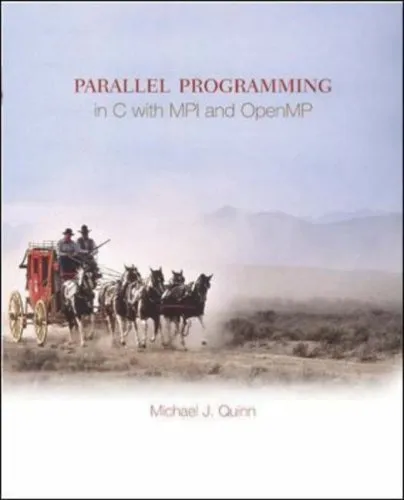
Book guide and evaluation
Michael J. Quinn
0 reviews
Published
pages
views
Introduction to "Parallel Programming in C with MPI and OpenMP" "Parallel Programming in C with MPI and OpenMP" is an authoritative guide on leveraging the power of parallel processing to accelerate computational tasks and enhance performance. Authored by Michael J. Quinn, t
Before you read
"Parallel Programming in C with MPI and OpenMP" is an authoritative guide on leveraging the power of parallel processing to accelerate computational tasks and enhance performance. Authored by Michael J. Quinn, this book serves both as a comprehensive introduction and a detailed resource for understanding concurrent programming using the two most widely adopted parallel programming models: MPI (Message Passing Interface) and OpenMP (Open Multi-Processing).
In today's computing environment, efficiency and speed are paramount. Computers equipped with multi-core processors have become ubiquitous, and software developers must utilize concurrent programming techniques to harness their full potential. This book provides a practical introduction to parallel programming concepts, using the C programming language as its foundation, and delves into two crucial libraries that support parallelism: MPI and OpenMP.
Through clear explanations and extensive examples, the book covers the core principles required to write parallel programs. It begins with a discussion of fundamental concepts such as concurrency and synchronization, moving into specific techniques for creating parallel code. The book explains both MPI and OpenMP from the ground up, providing detailed syntax, data types, and semantics for each library.
Readers will explore a variety of parallel computing topics, including data decomposition, load balancing, and multi-threaded programming. Each chapter is supplemented with practical examples and exercises, ensuring that readers not only understand the theory but also gain hands-on experience coding parallel applications.
"The transition from sequential to parallel programming can be challenging, but understanding the underlying principles is the key to unlocking performance gains."
"Parallel programming is not just about speed; it's about thinking differently about how problems are solved."
As multi-core and distributed computing systems become the norm, the ability to write efficient parallel programs is a critical skill for developers in various fields, from scientific computing to big data analytics. "Parallel Programming in C with MPI and OpenMP" is significant because it bridges the gap between theoretical concepts and practical application.
This book is crucial for educators, students, and professionals who aim to understand and apply parallel programming techniques. Its clear explanations and practical approach enable readers to transition from learning to implementing parallel solutions effectively. This makes it an indispensable resource for those looking to enhance their software's performance and scalability.
Moreover, by emphasizing both MPI and OpenMP, the book equips readers to tackle a wide range of parallel programming challenges, whether working with distributed systems or optimizing code for multi-core processors.
In conclusion, "Parallel Programming in C with MPI and OpenMP" is not just a textbook; it's a comprehensive toolkit designed to empower developers, enhance their skillset, and enable them to thrive in the rapidly evolving world of parallel computing.
Your question is answered in the context of this title and author. Each answer uses 2 points.
0 reviews, 4.5 average out of 5
Sign in to publish a review.
Ask a focused question and learn from the community.
Related references that continue this learning path.
Jeffers, Jim;Reinders, James

Jeffers, Jim;Reinders, James
Kathy Yelick (auth.),George Almási,Călin Caşcaval,Peng Wu (eds.)