

High Performance Parallelism Pearls Volume Two: Multicore and Many-core Programming Approaches
Jeffers, Jim;Reinders, James
2015
View book
Book guide and evaluation
Kathy Yelick (auth.),George Almási,Călin Caşcaval,Peng Wu (eds.)
0 reviews
Published
pages
views
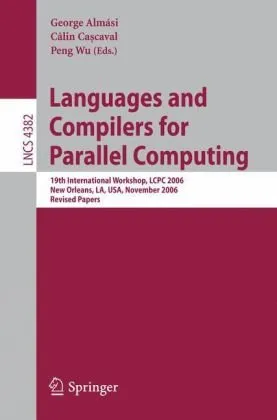
Introduction "Languages and Compilers for Parallel Computing: 19th International Workshop, LCPC 2006, Revised Papers" provides an in-depth exploration into the rapidly evolving world of parallel computing. Held in New Orleans in November 2006, this workshop brought togethe
Before you read
"Languages and Compilers for Parallel Computing: 19th International Workshop, LCPC 2006, Revised Papers" provides an in-depth exploration into the rapidly evolving world of parallel computing. Held in New Orleans in November 2006, this workshop brought together prominent figures, emerging researchers, and industry leaders to discuss and dissect the cutting-edge advancements, challenges, and innovations in the field of parallel computing. This book compiles revised and peer-reviewed papers presented during the workshop, detailing significant contributions that shape the future of parallel computing languages and compilers.
The book is an anthology of carefully selected papers that covers a broad spectrum of topics related to parallel computing. From optimization techniques and architectural considerations to innovative language constructs and compiler technologies, the authors address both theoretical and practical aspects. A recurring theme throughout the book is the quest for efficiency—both in terms of computational speed and resource management. The chapters delve into various paradigms for parallel programming, such as data parallelism, task parallelism, and hybrid models. Researchers present novel algorithms that enhance the performance of parallel programs and propose methodologies to improve compiler efficiency, which in turn optimizes code execution on parallel hardware.
A significant portion of the book is dedicated to real-world applications and case studies, providing empirical evidence and insights into how theoretical approaches are implemented. The discussions are complemented by extensive experimental results, including performance benchmarks across diverse computing environments.
"The efficiency of parallel computing thrives on the synergy between robust algorithms and intelligent compiler strategies."
"In the pursuit of computational speed, innovation in parallelism is not a luxury but a necessity."
This book is a cornerstone for professionals, researchers, and students in the field of computer science, specifically those focusing on parallel computing. In an era where processors with multiple cores are ubiquitous, understanding the intricacies of parallel computation is paramount. The insights provided by the workshop's expert contributors offer a diverse array of perspectives and solutions, essential for anyone looking to push the boundaries of what is computationally possible. By equipping readers with both theoretical knowledge and practical skills, this compilation of revised papers stands as a vital resource for advancing both academic research and industry applications in parallel computing.
Furthermore, the book serves as a valuable historical document capturing the state-of-the-art advancements in 2006, charting a course for developments over the subsequent decades. For those seeking to understand the trajectory of parallel computing and its myriad applications, this publication remains an essential read.
Your question is answered in the context of this title and author. Each answer uses 2 points.
0 reviews, 4.0 average out of 5
Sign in to publish a review.
Ask a focused question and learn from the community.
Related references that continue this learning path.
Jeffers, Jim;Reinders, James
David B. Kirk,Wen-mei W. Hwu
![Cover of The Art of Multiprocessor Programming [SMP]](https://s3.refhub.ir/images/thumb/The_Art_of_Multiprocessor_Programming__SMP_6496.webp)