Book guide and evaluation
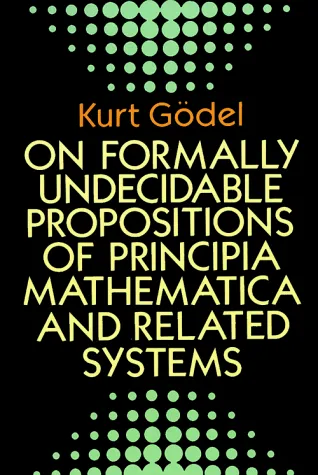
On Formally Undecidable Propositions of Principia Mathematica and Related Systems
Kurt Gödel
English
Beginner
Mathematical Logic
4.6 / 5
0 reviews
1992
Published
79
pages
608
views
Introduction to Gödel's Groundbreaking Work Kurt Gödel's monumental work, "On Formally Undecidable Propositions of Principia Mathematica and Related Systems," stands as one of the pillars of mathematical logic and philosophy. Published in 1931, this book marks a turning po
Before you read
What will you get from this book?
Introduction to Gödel's Groundbreaking Work
Kurt Gödel's monumental work, "On Formally Undecidable Propositions of Principia Mathematica and Related Systems," stands as one of the pillars of mathematical logic and philosophy. Published in 1931, this book marks a turning point in the field by demonstrating the inherent limitations of formal systems, reshaping the way we understand mathematics and its foundations.
Detailed Summary
In this seminal work, Gödel introduces what is now known as Gödel’s Incompleteness Theorems. The first of these theorems asserts that in any sufficiently powerful formal system, there are propositions that cannot be proven or disproven based on the axioms within that system. Specifically, Gödel showed that for any such system that is consistent (meaning it does not contain contradictions), there exists at least one "undecidable" proposition. This revelation implies that mathematical truth extends beyond formal proof.
The second incompleteness theorem takes this a step further by establishing that a formal system cannot prove its own consistency. Gödel begins his textured argumentative journey through the framework of Principia Mathematica and other related systems, which had initially aimed to use logic to underpin all of mathematics. By ingeniously encoding mathematical statements and using a method later known as "arithmetization," Gödel effectively demonstrates the limits of what can be achieved with formal logic.
Key Takeaways
- Formal systems, no matter how sophisticated, have intrinsic limitations.
- The concept of undecidable propositions underscores the existence of true mathematical statements that cannot be proven within the given system.
- Mathematical truth and provability are not equivalent, challenging previous assumptions of their interchangeability.
- Gödel's work has profound implications not only for mathematics but also for theories of computation, philosophy, and the nature of intelligence.
Famous Quotes from the Book
Gödel's work is filled with profound insights. Some of the notable quotations often cited from the book include:
"Every formal system sufficient for number theory contains undecidable propositions."
"The consistency of a formal system cannot be proven within the system itself."
Why This Book Matters
The significance of Gödel's book cannot be overstated. It punctured the ambitions of formalists who believed that all mathematical truth could be captured by formal systems and axioms. By revealing the intrinsic limitations of such systems, Gödel opened new avenues in mathematics, leading to developments in areas such as algebra, computer science, and even philosophy, particularly existentialism and the philosophy of mind.
Moreover, Gödel’s theorems provided a new perspective on the human mind’s capacity to understand and to transcend formal systems, thus influencing discussions about artificial intelligence and the possibility of machine understanding. The work raises essential questions about the nature of mathematical knowledge and the capabilities (and potential limits) of human reasoning.
In closing, "On Formally Undecidable Propositions of Principia Mathematica and Related Systems" is not just a cornerstone of logic and mathematical literature; it is a quest that calls into question the very foundation of what we consider provable and knowable. Gödel's insights continue to challenge and inspire mathematicians, philosophers, and scientists worldwide, making this book an essential read for anyone interested in the depths of logic and reasoning.
Ask this book
Your question is answered in the context of this title and author. Each answer uses 2 points.
Sign in to ask the book assistant.
Reader reviews
0 reviews, 4.6 average out of 5
No reviews yet
If you have read this book, help the next reader with your experience.
Write a review
Sign in to publish a review.
Reader questions and answers
Ask a focused question and learn from the community.
Sign in to ask or answer a question.
No questions yet
Be the first to ask a clear, useful question.
What to read next
Related references that continue this learning path.