

DNA Microarrays and Related Genomics Techniques: Design, Analysis, and Interpretation of Experiments (Biostatistics)
David B. Allison (Editor),Grier P. Page (Editor),T. Mark Beasley (Editor),Jode W. Edwards (Editor
2005
View book
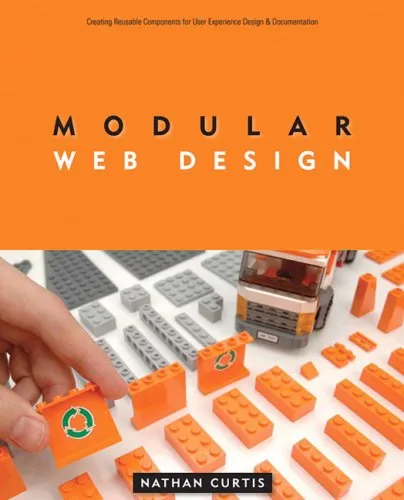
Book guide and evaluation
Nathan A. Curtis
0 reviews
Published
pages
views
Introduction to 'Modular Web Design: Creating Reusable Components for User Experience Design and Documentation' Discover the transformative approach to web design that empowers teams to create scalable, maintainable, and user-centric interfaces. 'Modular Web Design' is more th
Before you read
Discover the transformative approach to web design that empowers teams to create scalable, maintainable, and user-centric interfaces. 'Modular Web Design' is more than just a methodological framework—it is a paradigm shift towards building sustainable web ecosystems.
'Modular Web Design' addresses the challenges of modern web development by advocating for a component-based model. This book delves into the principles of modularity in design and development, promoting a methodology that supports agility, adaptability, and efficiency in creating web interfaces. It guides you through the construction of a coherent design system, ensuring that every part of your website not only serves its function but integrates seamlessly with other components. The approach is guided by the philosophy that web design should be both reusable and user-focused, allowing designers and developers to work in tandem to produce high-quality results.
Throughout the chapters, the book explores various techniques for designing and documenting user experience components. It bridges the gap between conceptual design and practical implementation, providing readers with a blueprint for developing consistent and engaging user journeys. The focus is on how modular web design can facilitate better communication within teams and lead to more sustainable and scalable products.
"When design and development speak the same language, the potential for innovation is limitless."
"Modularity isn't just about pieces; it's about the principles that allow those pieces to evolve in harmony."
In the rapidly evolving world of web design and development, maintaining a competitive edge requires tools and processes that support quick iteration and distribution of work. 'Modular Web Design' serves as an essential guide for those looking to implement a system that fosters collaboration, innovation, and scalability. By focusing on creating reusable components, the book aids teams in reducing the overhead of redundant work, allowing them to dedicate more resources to creativity and optimization.
This book is especially relevant for design and development professionals who encounter daily challenges in maintaining coherence in large-scale projects. It offers practical strategies and paradigms that are not only applicable to contemporary web projects but are also adaptable to future technological trends. By prioritizing a user-centric modular approach, 'Modular Web Design' ultimately leads to websites that are not only functional and visually appealing but are also equipped to grow and change as user needs demand.
Your question is answered in the context of this title and author. Each answer uses 2 points.
0 reviews, 4.8 average out of 5
Sign in to publish a review.
Ask a focused question and learn from the community.
Related references that continue this learning path.
David B. Allison (Editor),Grier P. Page (Editor),T. Mark Beasley (Editor),Jode W. Edwards (Editor
Rex Hartson,Pardha Pyla


Howard R. Moskowitz PhD,Sebastiano Porretta,Matthias Silcher