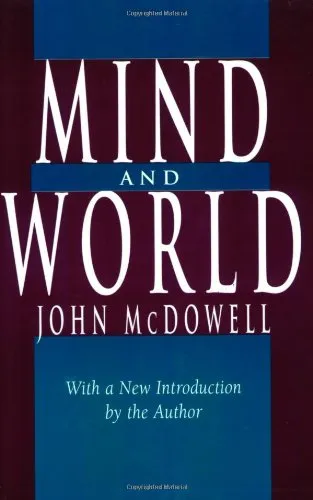
Book guide and evaluation
Mind and World
John McDowell
English
Beginner
Logic and Foundations
4.5 / 5
0 reviews
1996
Published
109
pages
587
views
Welcome to the introduction of "Mind and World," a profound exploration into the intricate relationship between human thinking and reality. Authored by John McDowell, this philosophical masterpiece delves deeply into epistemology, language, and our conceptual framework that med
Before you read
What will you get from this book?
Welcome to the introduction of "Mind and World," a profound exploration into the intricate relationship between human thinking and reality. Authored by John McDowell, this philosophical masterpiece delves deeply into epistemology, language, and our conceptual framework that mediates our interaction with the world.
Detailed Summary of the Book
"Mind and World" is a philosophical inquiry that addresses the perplexing question of how our minds relate to the world they aim to understand. In the tradition of analytic philosophy, McDowell addresses what he sees as a crisis within modern philosophy: the seeming disconnection between the mind's conceptual capacities and the empirical world of experience.
The book is structured around a series of lectures where McDowell critiques the prevalent philosophical perspectives that emphasize either a purely detached rationalism or a completely empirical naturalism. He argues that these perspectives lead to an unsatisfactory disjunction between mind and world. The book suggests that both experience and thought are shaped by our conceptual capacities, and thus intertwined with the natural world in which we live.
McDowell draws significantly from the works of philosophers like Kant, Hegel, and Wittgenstein, merging their insights into a coherent framework. He presents his arguments against the Cartesian dualism that separates mind from world and promotes a view that emphasizes how the mind is inherently structured to interpret the world through a conceptual scheme rooted in our natural faculties.
Key Takeaways
- The interplay between mind and world is mediated through language and concepts, suggesting a holistic integration rather than a dualistic separation.
- McDowell criticizes both reductive empiricism and extreme rationalism, seeking a middle path that allows for rational responsiveness to the world.
- The book reinterprets Kantian themes by advocating a blend of nature and freedom—asserting that humans are both natural beings and free rational agents.
- McDowell proposes that experiencing the world is an active engagement that requires conceptual capacities, not a passive reception of sensory inputs.
Famous Quotes from the Book
"We need to recapture the Aristotelian idea of the world as involving norms that natural beings can comply with or infringe on."
"Experience is openness to the layout of our surroundings, the openness made available by the form of conceptual capacities."
"What is necessary is a re-enchantment of nature, recovering a sense of the world that incorporates our logical grammar."
Why This Book Matters
Mind and World" is significant as it offers a fresh perspective on the longstanding debate regarding the mind's ability to engage with and understand reality. McDowell's insights have implications for various disciplines, including philosophy, cognitive science, and linguistics. By bridging the gap between subjective experience and objective reality, the book proposes a way to transcend the limits of previous theories which often failed to adequately account for the role of human conceptual activity in shaping experience.
Furthermore, the book's impact lies in its revival of a Kantian framework adjusted for contemporary debates. It helps restore confidence in the idea that humans can meaningfully connect their cognitive faculties with the world, providing a philosophical foundation for a more integrated and comprehensive understanding of human experience. As such, "Mind and World" continues to inspire and influence both new and seasoned philosophers in reevaluating the core principles of epistemology and the philosophy of mind.
Ask this book
Your question is answered in the context of this title and author. Each answer uses 2 points.
Sign in to ask the book assistant.
Reader reviews
0 reviews, 4.5 average out of 5
No reviews yet
If you have read this book, help the next reader with your experience.
Write a review
Sign in to publish a review.
Reader questions and answers
Ask a focused question and learn from the community.
Sign in to ask or answer a question.
No questions yet
Be the first to ask a clear, useful question.
What to read next
Related references that continue this learning path.

Word and Object
Willard Van Orman Quine,Dagfinn Føllesdal (Preface),Patricia Smith Churchland (Foreword)
2013
View book