Data-Driven Science and Engineering: Machine Learning, Dynamical Systems, and Control
Steven L. Brunton,J. Nathan Kutz
2019
View book
Book guide and evaluation
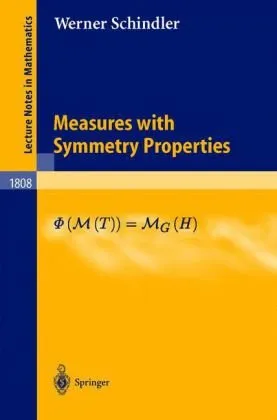
Werner Schindler (auth.)
0 reviews
Published
pages
views
Measures with Symmetry Properties Invariant measures, group actions Explore Measures with Symmetry Properties in depth — a rigorous study of invariant structures and symmetry in mathematical measure theory. Analytical Summary The book Measures with Symmetry Properties offer
Before you read
The book Measures with Symmetry Properties offers a thorough and mathematically precise exploration of measures that remain invariant under particular symmetry operations. It is aimed at readers with a strong foundation in measure theory, topology, and abstract algebra, and it systematically examines the interplay between symmetry and measure within a rigorous theoretical framework.
Authored by Werner Schindler, the work focuses on the conditions under which measures exhibit invariance, delving into the technical aspects of group actions, transformation groups, harmonic analysis, and related functional spaces. The author builds from foundational definitions toward complex theorems, ensuring that each concept is substantiated with logical clarity.
Rather than serving as a light introductory text, this book operates as a specialized mathematical treatise—ideal for graduate-level students, academics, and professionals in mathematics or theoretical physics who require a deep understanding of invariant measures. It also addresses historical developments and situates these ideas in the broader context of modern analysis.
Readers will gain both theoretical insights and practical tools for working with invariant measures, enabling application across pure and applied domains.
One significant advantage of Measures with Symmetry Properties lies in its structured approach to symmetry within measure spaces, offering clear definitions and theorems that can be directly adapted for research in ergodic theory, probability, and mathematical physics.
The emphasis on invariant measures and their link to group actions ensures that the reader comes away with a comprehensive framework for understanding not only abstract constructs but also their consequences in symmetrical systems.
The beauty of symmetry in mathematics lies in its power to reveal order within apparent complexity. Unknown
Invariant measures act as a mathematical anchor, holding structure steady amidst transformation. Unknown
Symmetry is not merely aesthetic; it is a principle of conservation in the language of mathematics. Unknown
Measures with Symmetry Properties occupies a precise and necessary niche in the mathematical literature, where symmetry plays a pivotal role in conceptual and applied analysis.
By providing rigorous proofs and methodical argumentation, Werner Schindler’s work enables readers to bridge the abstract nature of invariant theory with tangible problem-solving in mathematics and sciences. This synthesis is particularly relevant in fields like quantum mechanics, statistical mechanics, and crystallography, where symmetry principles underpin the models.
Information about awards or specific publication year is unavailable due to no reliable public source, yet the enduring relevance of the concepts discussed firmly ensures the text’s place in the scholar’s toolkit.
In tackling the often intricate relationship between measure and symmetry, Measures with Symmetry Properties equips the reader with both depth of theory and clarity of application.
Whether you are an academic pursuing original research, a professional mathematician exploring the depths of invariant measures, or a postgraduate student keen on mastering advanced concepts, this work provides the meticulous detail and structural coherence that make complex ideas accessible and applicable.
Engage with Measures with Symmetry Properties not merely as a text to be read, but as a source for discussion, collaboration, and further exploration of the profound role that symmetry plays in mathematical structures. Read, share, and debate its ideas—the next breakthrough could emerge from such dialogue.
Your question is answered in the context of this title and author. Each answer uses 2 points.
0 reviews, 3.8 average out of 5
Sign in to publish a review.
Ask a focused question and learn from the community.
Related references that continue this learning path.
Steven L. Brunton,J. Nathan Kutz