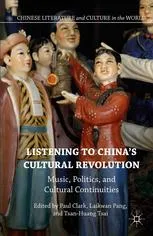
Book guide and evaluation
Listening to China’s Cultural Revolution: Music, Politics, and Cultural Continuities
Paul Clark,Laikwan Pang,Tsan-Huang Tsai (eds.)
English
Beginner
Art
4.5 / 5
0 reviews
2016
Published
284
pages
431
views
Introduction to "Listening to China’s Cultural Revolution: Music, Politics, and Cultural Continuities" "Listening to China’s Cultural Revolution: Music, Politics, and Cultural Continuities" is a groundbreaking anthology that delves into the often-overlooked world of music
Before you read
What will you get from this book?
Introduction to "Listening to China’s Cultural Revolution: Music, Politics, and Cultural Continuities"
"Listening to China’s Cultural Revolution: Music, Politics, and Cultural Continuities" is a groundbreaking anthology that delves into the often-overlooked world of music during one of China's most tumultuous periods — the Cultural Revolution (1966–1976). Edited by Paul Clark, Laikwan Pang, and Tsan-Huang Tsai, this book offers fresh perspectives on the intersections of art, politics, and society, revealing the intricate role that music played in shaping the cultural and political dynamics of China during this era.
The Cultural Revolution, largely defined by Chairman Mao Zedong's radical policies, sought to revolutionize Chinese culture, suppressing traditional art forms while promoting a "new" culture aligned with socialist ideals. Music, in this context, served not only as a political tool but also as a medium for expressing emotions, resistance, and conformity. By examining state-sponsored compositions, folk adaptations, and even underground musical movements, this book uncovers the complexities of music as both an artifact of propaganda and a medium of continuity and change.
Detailed Summary of the Book
The book is divided into thematic sections, each exploring a unique facet of music's role during the Cultural Revolution. It begins with an exploration of revolutionary songs endorsed by the Communist Party, which were instrumental in spreading Maoist ideology across rural and urban China. These songs, often performed on public stages and aired on government-controlled radio stations, served as powerful tools of political indoctrination.
Subsequent chapters delve into localized musical traditions and their adaptation during the Cultural Revolution. The authors document how regional styles, from classical Chinese opera to folk rhythms, were appropriated and transformed to align with revolutionary ideals. Yet, these adaptations reveal fascinating tensions — while the state enforced creative restrictions, musicians found ways to sneak resilience and individuality into their compositions.
Further, the book takes a closer look at underground and informal music practices that defied the rigidity of state control. These chapters showcase how music became a vehicle of subversion, expressing personal grief, collective nostalgia, and even silent rebellion. The final sections broaden the discussion to include the aftereffects of the Cultural Revolution on Chinese music, highlighting both the continuities and ruptures that followed.
Key Takeaways
- Music during the Cultural Revolution was a politically charged medium, used both as a tool for propaganda and as an outlet for resistance and unity.
- Revolutionary ideals shaped the development of new art forms, with traditional music often stripped of its original identity to serve state ideologies.
- Despite intense censorship, underground and informal music scenes flourished, offering a contrasting narrative to the state-led cultural project.
- Post-Cultural Revolution music reflects an enduring dialogue between past cultural norms and the innovations of that transformative decade.
Famous Quotes from the Book
"In revolutionary China, every stage was a battlefield of ideology; every note carried the weight of collective aspirations or defiance."
"Music was never merely an art form during the Cultural Revolution — it was both weapon and refuge."
"Even in the most restrictive times, the human spirit found ways to sing — in harmony with or in quiet defiance of state decrees."
Why This Book Matters
"Listening to China’s Cultural Revolution" is an essential contribution to the study of modern Chinese history, cultural studies, and musicology. By focusing on music, the book provides an alternative lens through which we can understand the complexities of the Cultural Revolution. It bridges the gap between political history and cultural analysis, highlighting how an art form as universal as music can be repurposed to serve ideological ends.
More importantly, it gives voice to the ordinary people and artists who lived and created under severe constraints, showcasing their resilience and creativity. This book reaffirms the importance of cultural expressions in understanding historical transformations, and it serves as a reminder that even in the darkest moments, the arts have the potential to preserve humanity and connect divided societies.
For students, scholars, and readers interested in Chinese culture, history, and politics, this book is a valuable resource. It not only deepens our understanding of a critical chapter in China's history but also demonstrates the enduring power of music as a force of cultural continuity and change.
Ask this book
Your question is answered in the context of this title and author. Each answer uses 2 points.
Sign in to ask the book assistant.
Reader reviews
0 reviews, 4.5 average out of 5
No reviews yet
If you have read this book, help the next reader with your experience.
Write a review
Sign in to publish a review.
Reader questions and answers
Ask a focused question and learn from the community.
Sign in to ask or answer a question.
No questions yet
Be the first to ask a clear, useful question.
What to read next
Related references that continue this learning path.