
Book guide and evaluation
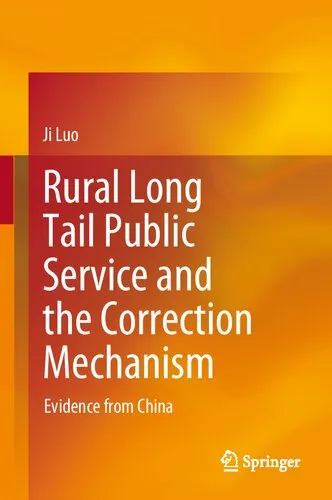
Rural Long Tail Public Service and the Correction Mechanism: Evidence from China
Ji Luo
English
Beginner
Art
4.9 / 5
0 reviews
2021
Published
274
pages
474
views
Introduction to "Rural Long Tail Public Service and the Correction Mechanism: Evidence from China" Welcome to the comprehensive exploration of public service mechanisms in rural China, where traditional and innovative strategies converge to address the long tail of underse
Before you read
What will you get from this book?
Introduction to "Rural Long Tail Public Service and the Correction Mechanism: Evidence from China"
Welcome to the comprehensive exploration of public service mechanisms in rural China, where traditional and innovative strategies converge to address the long tail of underserved communities. "Rural Long Tail Public Service and the Correction Mechanism: Evidence from China" delves deep into the systemic challenges and ingenious solutions that shape public service delivery in these areas.
Detailed Summary of the Book
In "Rural Long Tail Public Service and the Correction Mechanism: Evidence from China," we embark on an enlightening journey through the intricate landscape of rural public services. This book addresses the critical question: How can regions with sparse populations and limited resources receive adequate public services? By applying the Long Tail Theory, often used in business and economics, to public service delivery, this work uncovers insights into the distribution and accessibility of services in rural environments.
At the heart of this analysis is the "correction mechanism," a concept developed to rectify inefficiencies and inequities in service provision. Through extensive fieldwork and data analysis, the book presents compelling evidence and case studies from various provinces in China. Readers will gain an understanding of how local governments, non-profit organizations, and the private sector can collaboratively enhance service quality for the rural populace.
Key Takeaways
- The Long Tail Theory can be applied effectively to public service delivery, offering a new perspective on service allocation in rural regions.
- Correction mechanisms are vital for addressing disparities and ensuring equitable access to essential services in underserved areas.
- Collaborative efforts among stakeholders are crucial for the successful implementation and sustainability of these mechanisms.
- Policy implications of the study suggest targeted interventions and adaptive approaches to meet the unique needs of rural communities.
Famous Quotes from the Book
"The challenge of rural public service delivery lies not in the demand, but in recognizing and tapping into the latent potential of the long tail."
"Correction mechanisms do not merely patch the gaps—they weave new pathways, creating a mosaic of opportunity and access."
Why This Book Matters
This book is a pivotal contribution to the discourse on rural development and public administration. It breaks new ground by applying business concepts to public service issues, providing novel solutions for persistent challenges. The empirical evidence from China serves as a valuable case study for other developing regions facing similar obstacles. By highlighting the role of correction mechanisms, this work advocates for policy reforms and inspires future research in the field.
Ask this book
Your question is answered in the context of this title and author. Each answer uses 2 points.
Sign in to ask the book assistant.
Reader reviews
0 reviews, 4.9 average out of 5
No reviews yet
If you have read this book, help the next reader with your experience.
Write a review
Sign in to publish a review.
Reader questions and answers
Ask a focused question and learn from the community.
Sign in to ask or answer a question.
No questions yet
Be the first to ask a clear, useful question.
What to read next
Related references that continue this learning path.


Understanding China through Big Data: Applications of Theory-oriented Quantitative Approaches
Yunsong Chen,Guangye He,Fei Yan
2021
View book