Book guide and evaluation
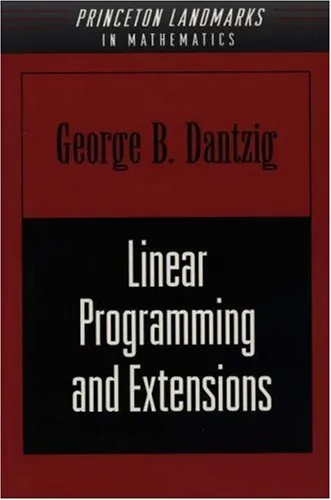
Linear Programming and Extensions
George Bernard Dantzig
English
Beginner
Applied Mathematics
4.4 / 5
0 reviews
1963
Published
4
pages
411
views
Welcome to the introduction to Linear Programming and Extensions, a seminal work in the field of optimization and operations research authored by George Bernard Dantzig, the father of linear programming. This book is not just a text for specialists in mathematics or operati
Before you read
What will you get from this book?
Welcome to the introduction to Linear Programming and Extensions, a seminal work in the field of optimization and operations research authored by George Bernard Dantzig, the father of linear programming. This book is not just a text for specialists in mathematics or operations research; it is a foundational resource for understanding how mathematical models can be applied to solve real-world problems across diverse disciplines, including economics, logistics, engineering, and more. In this introduction, we dive deep into the contents and the significance of this masterpiece.
Summary of the Book
Linear programming is one of the most applied and widely understood optimization techniques in modern problem-solving. In Linear Programming and Extensions, Dantzig explains the mathematical and computational principles that underlie this method, starting from its fundamental concepts to its real-world applications. The book begins with a thorough exploration of the simplex method, the algorithm that forms the backbone of solving linear programming problems. Included are detailed explanations augmented by worked examples to clarify complex concepts.
The text moves beyond the simplex method to more advanced topics such as duality theory, sensitivity analysis, network flows, and integer programming. It also explores the extension of linear programming to more general types of optimization, including nonlinear programming and approaches to handling uncertainty in problem data. With its comprehensive scope, this book provides a bridge between pure mathematical theory and practical applications. Whether your focus is manufacturing, supply chain optimization, resource allocation, or scheduling, this book provides tools and strategies that are timeless and scalable.
Key Takeaways
- A deep understanding of the simplex method and its mathematical foundations, including geometry and algebraic techniques.
- Insights into duality and its practical implications in economics and decision-making.
- The formulation and modeling of real-world problems using linear programming language.
- Extensions of linear programming to network problems, integer programming, and nonlinear optimization.
- Historical perspective on the development of operations research and optimization methodologies.
Famous Quotes from the Book
“The development of linear programming is one of the most important advances in mathematics applied to economic, social, and organizational sciences.”
“Optimization is not merely finding the best solution but understanding what makes it the best and how robust it is under changes in conditions.”
Why This Book Matters
Published in 1963, Linear Programming and Extensions is a cornerstone in the field of optimization. George Bernard Dantzig’s contributions were revolutionary, providing researchers, scientists, and industry practitioners a structured approach to solve problems that were once deemed intractable. The techniques and methodologies introduced in this work have since become essential tools in industries ranging from logistics and manufacturing to finance and public policy. In fact, the publication of this book inspired multiple advances not only in mathematical theory but also in the development of computational algorithms and modern software tools for optimization.
Moreover, this book transcends its technical boundaries by exploring philosophical and applied dimensions of decision-making. It teaches not only how to solve mathematical models but also how to think critically about resource use, priorities, and trade-offs—a valuable skill for professionals in any field. Despite the book’s technical nature, Dantzig’s clarity of explanation ensures its accessibility to readers with varying levels of expertise, making it an indispensable resource for students, educators, and practitioners alike.
By the time you finish this book, you will not only be better equipped to solve optimization problems but will also gain a renewed appreciation for the elegance and power of mathematics as a tool for understanding and improving the world around us.
Ask this book
Your question is answered in the context of this title and author. Each answer uses 2 points.
Sign in to ask the book assistant.
Reader reviews
0 reviews, 4.4 average out of 5
No reviews yet
If you have read this book, help the next reader with your experience.
Write a review
Sign in to publish a review.
Reader questions and answers
Ask a focused question and learn from the community.
Sign in to ask or answer a question.
No questions yet
Be the first to ask a clear, useful question.
What to read next
Related references that continue this learning path.
Data-Driven Science and Engineering: Machine Learning, Dynamical Systems, and Control
Steven L. Brunton,J. Nathan Kutz
2019
View book