
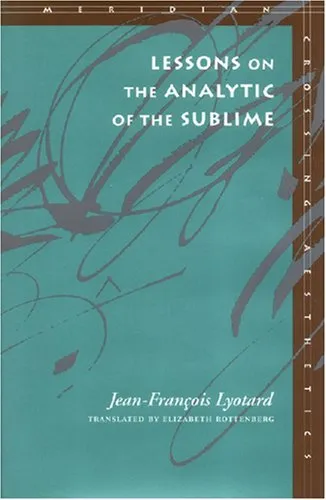
Lessons on the Analytic of the Sublime (Meridian: Crossing Aesthetics)
Jean-Francois Lyotard
1994
View book
Book guide and evaluation
Jean-François Lyotard
0 reviews
Published
pages
views
Introduction Welcome to an in-depth exploration of Jean-François Lyotard's "Lessons on the Analytic of the Sublime: Kant's Critique of Judgment, Sections 23-29." This book offers a profound analysis of Immanuel Kant's treatment of the sublime within his seminal work, the "
Before you read
Welcome to an in-depth exploration of Jean-François Lyotard's "Lessons on the Analytic of the Sublime: Kant's Critique of Judgment, Sections 23-29." This book offers a profound analysis of Immanuel Kant's treatment of the sublime within his seminal work, the "Critique of Judgment." Lyotard provides a masterful elucidation of Kant's exploration of the sublime, which is both daunting and alluring, stirring the faculties of imagination and reason in unique ways.
The book offers readers an intricate examination of the concept of the sublime, delving into its philosophical underpinnings and why it continues to be a critical element in aesthetic discourse. Through Lyotard's engaging narrative and critical insight, the reader is invited to journey through Kant's thoughts on how the experience of the sublime serves to enrich human experience, challenging our cognitive capacities and emotional responses.
Jean-François Lyotard embarks on an ambitious analytical journey through Kant's sections on the sublime, highlighting the intricate relationship between imagination and reason that defines our encounter with the vast, the formless, and the overwhelming. Lyotard approaches Kant's text not merely as a historical document but as a living dialogue with modern aesthetic and philosophical thought. He deconstructs Kant’s notions, emphasizing their relevance to contemporary debates on aesthetic theory, postmodern ideas, and cultural criticism.
The book is meticulously structured to walk the reader through the dense philosophical terrain that Kant presents. Lyotard examines the concept that the sublime is a discursive space where human faculties are pushed to their limits. This engagement with the limits allows an introspection into the nature of fear, awe, and the human condition, making sense of the seemingly senseless and grappling with experiences that resist total comprehension.
"The sublime, then, is where the faculties of the human mind engage in a form of aesthetic rivalry with each other."
"In the experience of the sublime, we find the recognition of an excess beyond measure, a movement that transgresses the boundaries of rational apprehension."
Lyotard's work is essential for those interested in deepening their understanding of both Kantian philosophy and the broader discourse of the sublime within aesthetic theory. It bridges Kantian insights with contemporary thought, illustrating the relevance of philosophical concepts in analyzing modern cultural and artistic phenomena. The book is also critical for those exploring the intersections between postmodern theory and traditional philosophical inquiries, providing a platform for intellectual dialogue and cross-examination.
Moreover, "Lessons on the Analytic of the Sublime" serves as a significant text for those seeking to comprehend the profound impact of the sublime on human cognition, creativity, and cultural expression. It is a testament to Lyotard's intellectual prowess and his ability to make complex ideas accessible and relevant to modern audiences.
Your question is answered in the context of this title and author. Each answer uses 2 points.
0 reviews, 4.1 average out of 5
Sign in to publish a review.
Ask a focused question and learn from the community.
Related references that continue this learning path.
Jean-Francois Lyotard
Edited by Paul Guyer. Contributors: Paul Guyer,Nick Zangwill,Christopher Janaway,Anthony Savile,Eva Schaper,Malcolm Budd,Donald W. Crawford,Brigitte Sassen,Lambert Zuidevaart,Jane Kneller,Peter McLaughlin,Henry E. Allison