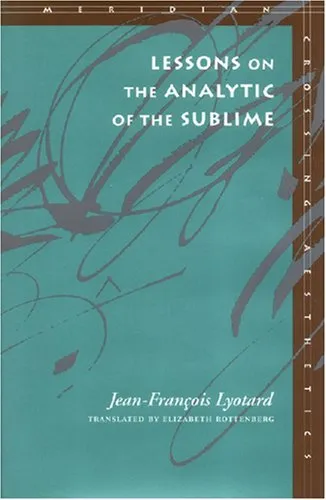
Lessons on the Analytic of the Sublime (Meridian: Crossing Aesthetics)
Jean-Francois Lyotard
1994
View book
Book guide and evaluation
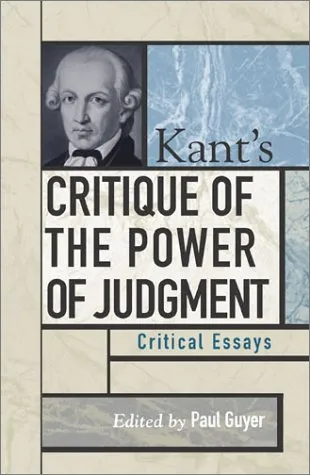
Edited by Paul Guyer. Contributors: Paul Guyer,Nick Zangwill,Christopher Janaway,Anthony Savile,Eva Schaper,Malcolm Budd,Donald W. Crawford,Brigitte Sassen,Lambert Zuidevaart,Jane Kneller,Peter McLaughlin,Henry E. Allison
0 reviews
Published
pages
views
Introduction to "Kant's Critique of the Power of Judgment: Critical Essays" Edited by Paul Guyer and featuring contributions from esteemed scholars such as Nick Zangwill, Christopher Janaway, and Eva Schaper, "Kant's Critique of the Power of Judgment: Critical Essays" offe
Before you read
Edited by Paul Guyer and featuring contributions from esteemed scholars such as Nick Zangwill, Christopher Janaway, and Eva Schaper, "Kant's Critique of the Power of Judgment: Critical Essays" offers a comprehensive exploration into Immanuel Kant's profound work on aesthetics and teleology. This collection is an essential resource for anyone seeking a deep understanding of Kant’s third Critique and its enduring impact on philosophical thought.
"Kant's Critique of the Power of Judgment: Critical Essays" delves into the complexities of Kant’s theories on judgment, beauty, and the sublime. The book is structured to facilitate a rich analysis of the two main parts of Kant's Critique: the 'Critique of Aesthetic Judgment' and the 'Critique of Teleological Judgment'. Each essay examines the nuances of Kant's arguments, providing insights into his philosophy, especially concerning the unity of human experience and the interrelation of our cognitive faculties.
The first set of essays focuses on aesthetic judgment, discussing Kant's idea that aesthetic experience is a unique form of awareness, distinct from both cognitive and moral spheres. This section includes a critical evaluation of Kant's famous concepts like disinterestedness in aesthetics and the universality of aesthetic judgments. The subsequent essays explore teleological judgment, providing in-depth discussions on Kant's argument that nature itself is purposive, which is crucial for understanding the systematic unity of all our cognitive capacities.
Each contributor brings a unique perspective, ensuring that the book covers a diverse range of interpretations and critiques of Kant's seminal work. The essays collectively argue for the continued relevance of Kant's ideas not only in philosophy but also in fields like art theory, biology, and environmental ethics.
Although this collection does not directly attribute new quotes, it meticulously analyzes significant passages from Kant’s own work in the Critique of the Power of Judgment. Here are a few excerpts that the book might tackle:
"The beautiful is that which, apart from a concept, pleases universally." — Immanuel Kant, Critique of the Power of Judgment
"Judgments of taste are, accordingly, not determinable by means of proofs but may only be expected to receive confirmation through the agreement of others." — Immanuel Kant, Critique of the Power of Judgment
Kant's "Critique of the Power of Judgment" is pivotal to understanding modern aesthetic theory and philosophy. This collection of essays is significant because it offers a diverse range of interpretations and critiques by leading Kant scholars, making complex ideas accessible while stimulating further scholarly discussion. By explicating Kant’s theories with clarity and depth, the book plays a crucial role in enriching the reader’s appreciation of the intersection between aesthetics and philosophy.
In addition to its philosophical significance, "Kant's Critique of the Power of Judgment: Critical Essays" contributes to contemporary debates on how aesthetic experiences influence ethical and environmental considerations. By engaging with this book, readers gain a deeper grasp of how Kant’s ideas can be applied to current issues, demonstrating the timeless nature of his thought.
Your question is answered in the context of this title and author. Each answer uses 2 points.
0 reviews, 4.0 average out of 5
Sign in to publish a review.
Ask a focused question and learn from the community.
Related references that continue this learning path.
Jean-Francois Lyotard