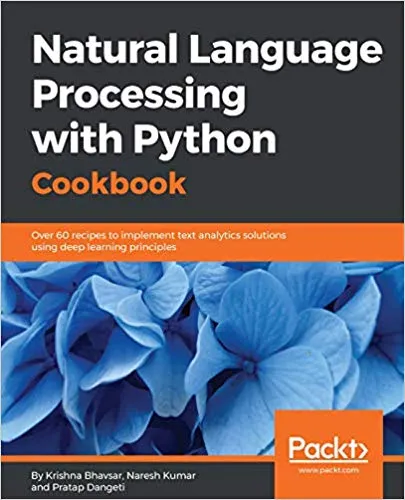
Natural Language Processing with Python Cookbook: Over 60 recipes to implement text analytics solutions using deep learning principles
Krishna Bhavsar,Naresh Kumar,Pratap Dangeti
2017
View book
Book guide and evaluation
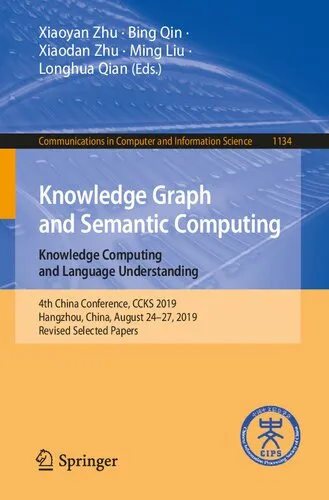
Xiaoyan Zhu (editor),Bing Qin (editor),Xiaodan Zhu (editor),Ming Liu (editor),Longhua Qian (editor)
0 reviews
Published
pages
views
Introduction The book "Knowledge Graph and Semantic Computing: Knowledge Computing and Language Understanding" is a comprehensive compilation of cutting-edge research and practical advancements in the domains of knowledge graphs, semantic computing, and their integration
Before you read
The book "Knowledge Graph and Semantic Computing: Knowledge Computing and Language Understanding" is a comprehensive compilation of cutting-edge research and practical advancements in the domains of knowledge graphs, semantic computing, and their integration with natural language understanding. This book encapsulates the major findings and innovations presented during the 4th China Conference on Knowledge Graph and Semantic Computing (CCKS 2019), held in Hangzhou, China. It is a vital resource for researchers, academics, and industry professionals eager to explore the intersections of artificial intelligence, knowledge representation, and language technologies.
Authored and edited by highly esteemed scholars, this book is part of the prestigious "Communications in Computer and Information Science" series, known for its scientific rigor and depth. The CCKS 2019 conference provided a platform for thought leaders and practitioners to share their findings, facilitating rich discussions and innovation around knowledge graphs and semantic computing, two areas that are driving a revolution in artificial intelligence research and applications.
The content of this book takes readers on an intellectual journey through various aspects of knowledge graph construction, semantic reasoning, and their applications in natural language understanding and beyond. The chapters are structured around a combination of theoretical frameworks, algorithmic developments, and real-world use cases.
The first sections of the book focus on methods and practices for building and optimizing knowledge graphs. This includes discussions on data acquisition, preprocessing, and representation techniques leveraging both structured and unstructured sources of information. Innovative approaches for entity recognition, relationship extraction, and ontology modeling are also explored in detail.
Further chapters delve into semantic computing, an area that bridges computational models and meaningful data interpretation. The authors present powerful techniques for semantic reasoning, query optimization, and context-based information retrieval. Special emphasis is given to the application of semantic technologies in domains such as healthcare, education, and business intelligence.
A significant portion of the book is dedicated to natural language processing (NLP) tasks, such as dialogue systems, machine translation, and question-answering systems. By demonstrating how knowledge graphs are utilized to enhance language understanding and generate accurate, meaningful responses, the book highlights the synergy between knowledge representation and language technologies.
Lastly, the book provides unique insights into emerging trends, challenges, and opportunities in knowledge graphs and semantic computing, encouraging readers to envision future innovations in this exciting field.
"A truly intelligent system is one that not only processes information but also understands the meaning behind it."
"Knowledge graphs and semantic computing aren't just tools—they are bridges connecting human cognition with machine intelligence."
"The future of AI lies in its ability to reason, infer, and relate information as humans do, and knowledge graphs are the foundation of that future."
In an era where information is the most valuable resource, understanding how to structure, compute, and apply it is of paramount importance. This book addresses this imperative need by exploring knowledge graphs and semantic computing—two complementary fields that are reshaping the AI landscape. It provides a unified view of how machines can interpret, reason with, and utilize data in ways that mimic human understanding.
By compiling the latest advancements from the CCKS 2019 conference, this book serves as more than just a collection of research papers; it is a roadmap for anyone seeking to develop innovative AI applications. The methodologies, tools, and conclusions presented in this book empower researchers, students, and professionals to tackle complex challenges in AI, data science, and information management.
Whether you are building intelligent search engines, improving NLP systems, or exploring new possibilities in data integration, this book offers foundational knowledge, practical solutions, and pathways for future exploration. Its significance lies not only in its technical depth but also in its vision for the future of AI, making it a must-read for anyone interested in the intersections of technology, knowledge, and language.
Your question is answered in the context of this title and author. Each answer uses 2 points.
0 reviews, 4.0 average out of 5
Sign in to publish a review.
Ask a focused question and learn from the community.
Related references that continue this learning path.
Krishna Bhavsar,Naresh Kumar,Pratap Dangeti