The Principia: Mathematical Principles of Natural Philosophy
Isaac Newton,I. Bernard Cohen,Anne Whitman,Julia Budenz
1999
View book
Book guide and evaluation
E. A. Davis
0 reviews
Published
pages
views
Introduction The book 'J.J. Thomson and the Discovery of the Electron' explores one of the most groundbreaking moments in the history of science. Written with meticulous detail, this book delves into the life and work of Sir J.J. Thomson, the physicist whose discov
Before you read
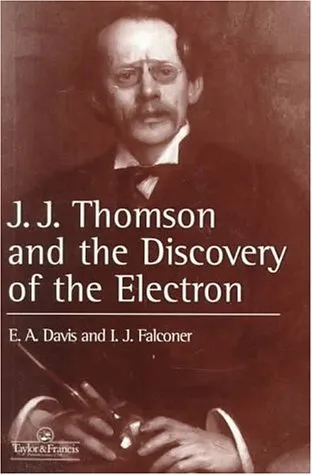
The book 'J.J. Thomson and the Discovery of the Electron' explores one of the most groundbreaking moments in the history of science. Written with meticulous detail, this book delves into the life and work of Sir J.J. Thomson, the physicist whose discovery of the electron revolutionized the way we understand the universe. From the enigmatic world of atoms to the dawn of quantum physics, this book serves as both a historical account and an insightful tribute to one of the most significant achievements in modern science.
The late 19th century was an era of transformation in physics, as new concepts and groundbreaking discoveries began to challenge centuries-old assumptions. Among these transformative events, J.J. Thomson's discovery of the electron in 1897 stands out as a cornerstone of modern scientific thought. This book not only outlines the scientific journey but also offers a broader look at the cultural and philosophical implications of Thomson's work. Aimed at readers with varied levels of scientific understanding, this comprehensive account breaks down complex ideas into digestible narrative threads. Readers will leave with not only an understanding of the discovery of the electron but also its enduring legacy in fields such as chemistry, materials science, and electronics.
'J.J. Thomson and the Discovery of the Electron' takes readers on a journey that is as much about the man as it is about the science. The book begins by introducing the historical context of late 19th-century physics, a time when the atomic model was still a subject of wild speculation. It explores the intellectual and social environment in which J.J. Thomson grew up, providing key insights into his early life, education, and career trajectory.
Central to the narrative is Thomson's painstaking experimentation at Cambridge University's Cavendish Laboratory. The book vividly describes Thomson's groundbreaking cathode ray experiments, which led to his proposition of the existence of subatomic particles—what we now know as electrons. Thomson's meticulous approach, coupled with his ability to synthesize experimental data into theoretical frameworks, is portrayed in compelling detail.
The book also sheds light on the intellectual debates and resistance from the scientific establishment, as the discovery of the electron challenged long-held assumptions about the indivisibility of atoms. Beyond the laboratory, it examines the far-reaching implications of the discovery, tracing its influence on later scientific advancements, including quantum mechanics and the development of modern electronics. The narrative weaves together history, science, and biography to create an engaging and thought-provoking portrait of a pivotal moment in human understanding.
"In the story of science, the discovery of the electron is not merely a chapter; it is a foundational cornerstone upon which the edifice of modern physics stands."
"Thomson understood that breakthroughs are not born from isolated moments of genius but are the cumulative result of discipline, collaboration, and imagination."
"The discovery of the electron was not just an addition to scientific knowledge—it fundamentally altered our grasp of reality."
Understanding the discovery of the electron is critical for anyone interested in science, technology, or history. J.J. Thomson's work laid the foundation for practically every technological innovation of the modern era, from semiconductors to X-ray machines. By piecing together the narrative of Thomson's life and scientific career, this book illuminates how curiosity, determination, and critical inquiry can lead to groundbreaking discoveries.
Moreover, the story of the electron's discovery is a reminder of the profound connections between science and the larger cultural framework in which it evolves. It challenges readers to think about how ideas are born and how they overturn deep-rooted assumptions. Whether you are a scientist, historian, or simply someone with a passion for discovery, this book provides a rich exploration of a scientific milestone that reshaped our understanding of the universe forever.
Your question is answered in the context of this title and author. Each answer uses 2 points.
0 reviews, 4.5 average out of 5
Sign in to publish a review.
Ask a focused question and learn from the community.
Related references that continue this learning path.
Isaac Newton,I. Bernard Cohen,Anne Whitman,Julia Budenz