
Book guide and evaluation
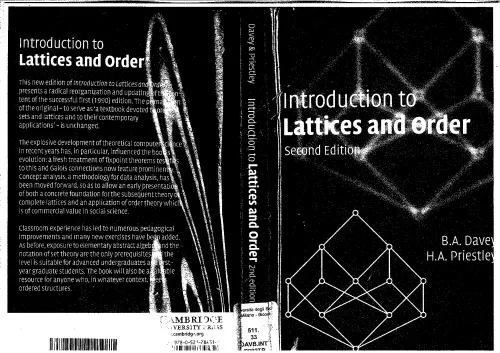
Introduction to Lattices and Order
B. Davey,H. Priestley
English
Beginner
Set Theory
4.5 / 5
0 reviews
2002
Published
156
pages
625
views
Welcome to the comprehensive introduction to the book "Introduction to Lattices and Order" by B. Davey and H. Priestley. Designed for students, mathematicians, and professionals interested in the framework of lattice theory and order, this book acts as both a textbook and a
Before you read
What will you get from this book?
Welcome to the comprehensive introduction to the book "Introduction to Lattices and Order" by B. Davey and H. Priestley. Designed for students, mathematicians, and professionals interested in the framework of lattice theory and order, this book acts as both a textbook and a valuable reference guide. Combining theory with practical applications, it encourages readers to explore the mathematical structures and logic underlying lattice theory. Let us delve into the essential sections that define this pivotal piece of literature.
Detailed Summary of the Book
"Introduction to Lattices and Order" navigates through the fundamental principles of lattice theory intertwined with order. The authors systematically introduce basic concepts starting from partially ordered sets, followed by an exploration of the lattice as an algebraic structure. The narrative progresses to discuss complete lattices and Galois connections, offering readers a robust understanding of both theoretical and applied aspects.
The book is well-structured with clear definitions and theorems, bolstered by illustrative examples that elucidate complex ideas. Topics like modular and distributive lattices are presented in detail, offering insights into their significance and application in computer science, formal concept analysis, and logic. Furthermore, the inclusion of exercises throughout the chapters ensures active engagement with the material while building problem-solving skills.
Key Takeaways
- Comprehend the foundational aspects of lattices and order theory, including partially ordered sets and lattice operations.
- Gain insights into the special types of lattices, such as modular and distributive lattices, and their applications.
- Learn to apply lattice theory in practical scenarios, particularly in areas like computer science and discrete mathematics.
- Enhance mathematical reasoning and proof-writing skills through a structured exposition of theorems and exercises.
Famous Quotes from the Book
"A lattice is a neat and compact collection of elements arranged according to rules which describe the partial ordering relations among them."
"Order theory provides a lens through which we can understand and unify a vast array of mathematical structures."
Why This Book Matters
"Introduction to Lattices and Order" serves as a crucial text for those venturing into the mathematics of order and algebraic structures. The meticulously crafted exposition allows learners to unravel the intricacies of order theory within a broader mathematical context. Its importance is underscored by its utility in disciplines ranging from computer science to engineering, where understanding complex hierarchies and relationships is imperative.
What sets this book apart is its balance between rigorous academia and accessible explanation, making it appealing to both newcomers and experienced mathematicians. Whether you're embarking on research or seeking a reference guide for complex mathematical structures, this book provides the tools needed to appreciate and apply lattice theory aligned with real-world applications.
Ask this book
Your question is answered in the context of this title and author. Each answer uses 2 points.
Sign in to ask the book assistant.
Reader reviews
0 reviews, 4.5 average out of 5
No reviews yet
If you have read this book, help the next reader with your experience.
Write a review
Sign in to publish a review.
Reader questions and answers
Ask a focused question and learn from the community.
Sign in to ask or answer a question.
No questions yet
Be the first to ask a clear, useful question.
What to read next
Related references that continue this learning path.
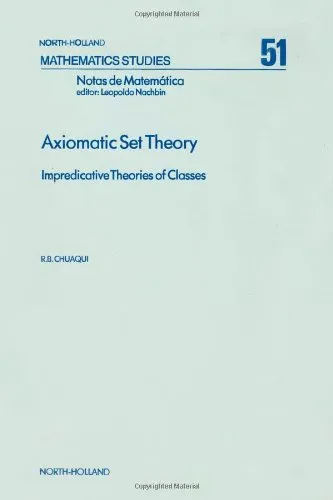
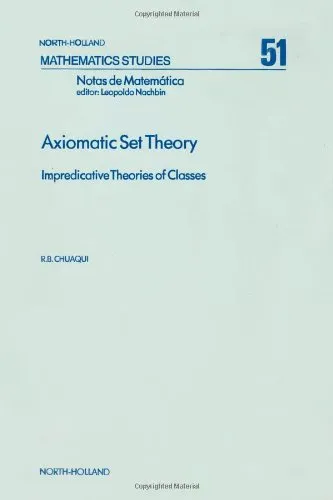
Axiomatic Set Theory: Theory Impredicative Theories of Classes
Leopoldo Nachbin (Eds.)
1981
View book
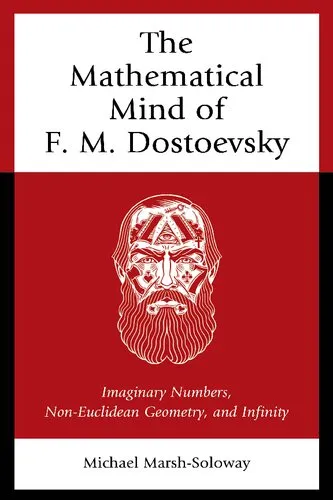
The Mathematical Mind of F. M. Dostoevsky: Imaginary Numbers, Non-Euclidean Geometry, and Infinity
Michael Marsh-Soloway
2024
View book