
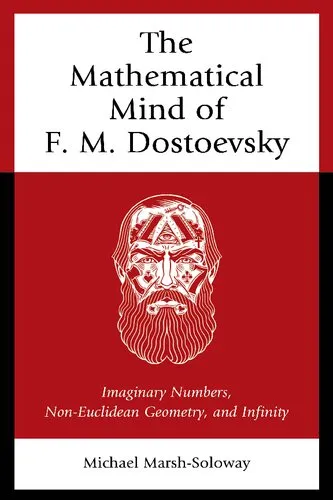
Book guide and evaluation
The Mathematical Mind of F. M. Dostoevsky: Imaginary Numbers, Non-Euclidean Geometry, and Infinity
Michael Marsh-Soloway
English
Beginner
Set Theory
4.7 / 5
0 reviews
2024
Published
365
pages
544
views
Introduction "The Mathematical Mind of F. M. Dostoevsky: Imaginary Numbers, Non-Euclidean Geometry, and Infinity" is a groundbreaking exploration into the lesser-known dimension of Fyodor Mikhailovich Dostoevsky's genius. Renowned as one of the greatest novelists of all ti
Before you read
What will you get from this book?
Introduction
"The Mathematical Mind of F. M. Dostoevsky: Imaginary Numbers, Non-Euclidean Geometry, and Infinity" is a groundbreaking exploration into the lesser-known dimension of Fyodor Mikhailovich Dostoevsky's genius. Renowned as one of the greatest novelists of all time, Dostoevsky's works have delved into the intricacies of the human psyche, morality, and existential inquiry. This book, however, ventures into an extraordinary realm where literature and mathematics intersect, revealing how mathematical concepts influenced Dostoevsky's philosophical narratives and fictional landscapes.
Detailed Summary
This book challenges the conventional perception of Dostoevsky as solely a literary figure by illuminating his profound engagement with mathematical ideas. It uncovers the intriguing ways in which Dostoevsky employed mathematical principles as metaphors, tools of logic, and symbols of existential conundrums. Readers will journey through aspects of mathematics such as imaginary numbers, non-Euclidean geometry, and infinity, which serve not merely as abstract notions but as vital components in the thematic architecture of Dostoevsky's novels.
The narrative begins by contextualizing Dostoevsky's era, a time when mathematics was dramatically evolving. The book examines the influence of contemporary scientific thought on Dostoevsky’s work, revealing his fascination with the philosophical implications of mathematical innovation. Subsequently, it dissects specific works such as "The Brothers Karamazov," "Crime and Punishment," and "The Double," highlighting instances where mathematical themes subtly yet potently underscore the moral and ethical dilemmas confronted by his characters.
Key Takeaways
- Mathematics in Dostoevsky's writing is not purely numerical or logical but is deeply philosophical, merging with existential and ethical inquiries.
- The portrayal of infinity and the fourth dimension in his works reflects a unique fusion of science and literature, inviting readers to explore the concept of the infinite beyond its mathematical definitions.
- Dostoevsky's engagement with non-Euclidean geometry disrupts classical narrative structures, mirroring the complexities and chaos of human consciousness and morality.
- His use of imaginary numbers symbolizes the illogical and paradoxical elements of human nature, challenging the notion of absolute truth.
Famous Quotes from the Book
"Mathematics for Dostoevsky was akin to a divine language, an abstract yet compelling force that could unravel the mysteries of the human soul."
"Dostoevsky's novels are not just narratives; they are intricate tapestries where numbers, lines, and infinite possibilities merge with the profoundest of human questions."
Why This Book Matters
This work is pivotal as it unites two seemingly disparate fields—mathematics and literature—and positions Dostoevsky at this confluence, showcasing his multi-dimensional intellect. For scholars and enthusiasts of literature, philosophy, and mathematics, this book offers fresh insights into Dostoevsky's oeuvre, encouraging a re-interpretation of his classic works through a mathematical lens. It also highlights the broader cultural implications of mathematics in shaping philosophical thought, providing contemporary readers with tools to appreciate the interconnectedness of scientific and artistic disciplines.
By delving into "The Mathematical Mind of F. M. Dostoevsky," readers are invited to transcend conventional literary analysis and embrace a more holistic approach to understanding Dostoevsky, one that appreciates the brilliance of his mind not just as a storyteller but as a thinker engaged with the profound mathematical concepts that continue to influence our world today.
Ask this book
Your question is answered in the context of this title and author. Each answer uses 2 points.
Sign in to ask the book assistant.
Reader reviews
0 reviews, 4.7 average out of 5
No reviews yet
If you have read this book, help the next reader with your experience.
Write a review
Sign in to publish a review.
Reader questions and answers
Ask a focused question and learn from the community.
Sign in to ask or answer a question.
No questions yet
Be the first to ask a clear, useful question.
What to read next
Related references that continue this learning path.
Axiomatic Set Theory: Theory Impredicative Theories of Classes
Leopoldo Nachbin (Eds.)
1981
View book