Book guide and evaluation
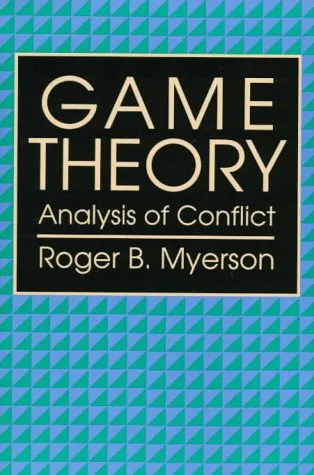
Game Theory: Analysis of Conflict
Roger B. Myerson
English
Beginner
Applied Mathematics
4.4 / 5
0 reviews
1997
Published
587
pages
1241
views
Welcome to the insightful world of "Game Theory: Analysis of Conflict." Authored by Roger B. Myerson, this seminal work is a comprehensive exploration of game theory, presenting both a theoretical and practical framework to understand and analyze strategic interactions
Before you read
What will you get from this book?
Welcome to the insightful world of "Game Theory: Analysis of Conflict." Authored by Roger B. Myerson, this seminal work is a comprehensive exploration of game theory, presenting both a theoretical and practical framework to understand and analyze strategic interactions in conflicts. The book is a profound contribution to economics, political science, and beyond, as it delves into the dynamics of strategic decision-making processes.
Summary of the Book
"Game Theory: Analysis of Conflict" is a meticulous guide designed for scholars, researchers, and practitioners who seek to grasp the nuances of strategic conflict analysis. The book meticulously covers key concepts of game theory, ensuring readers can apply these principles to real-world scenarios. Myerson carefully builds the foundation with fundamental theories and concepts, progressing to advanced topics such as Nash equilibrium, Bayesian games, cooperative game theory, and mechanism design.
The book differentiates itself by its depth and breadth of coverage, exploring various forms of games – including zero-sum games, repeated games, and multistage games. Myerson's unique approach contextualizes these games within conflicts ranging from economic competition to political negotiations, providing a lens to discern the complexities of strategic interactions and resolutions.
Key Takeaways
- Comprehensive introduction to the principles of game theory and its application to conflict analysis.
- In-depth explanation of Nash Equilibrium and its significance in strategic decision-making.
- A thorough understanding of cooperative and non-cooperative game contexts.
- Detailed exploration of Bayesian games and information asymmetry.
- Insight into mechanism design and the implications for economic theory and policy making.
Famous Quotes from the Book
"In any strategic interaction, understanding what your adversary will do in response to your actions is the essence of game theory."
"The power of game theory lies in its ability to provide a rigorous framework for analyzing the human interactions that shape economic and social institutions."
Why This Book Matters
Roger B. Myerson's "Game Theory: Analysis of Conflict" stands as a quintessential text in understanding the mathematical underpinnings and practical applications of game theory. It is crucial for anyone seeking to deepen their comprehension of strategic interactions and their outcomes. This book not only enriches academic discourse but also offers invaluable tools for decision-makers in economics, politics, and business.
Beyond the academic realm, the insights drawn from Myerson's work have far-reaching implications in shaping strategies and policies in various sectors. By applying the principles discussed in this book, individuals and organizations can discern more effective strategies to navigate complex negotiation landscapes, making informed and strategic choices that affect both competition and cooperation.
Ask this book
Your question is answered in the context of this title and author. Each answer uses 2 points.
Sign in to ask the book assistant.
Your previous questions
Does the theory of games count as a quantitative methods of research in economics?
Yes, the theory of games can be considered a quantitative method of research in economics. In "Game Theory: Analysis of Conflict," I emphasize that game theory provides a systematic and mathematical framework for analyzing strategic interactions among rational decision-makers. This involves quantitative tools such as utility functions, probabilities, payoff matrices, and equilibrium concepts like Nash equilibrium. These tools allow economists to model and analyze situations where the outcomes depend not only on an individual’s choices but also on the choices of others.
Reader reviews
0 reviews, 4.4 average out of 5
No reviews yet
If you have read this book, help the next reader with your experience.
Write a review
Sign in to publish a review.
Reader questions and answers
Ask a focused question and learn from the community.
Sign in to ask or answer a question.
No questions yet
Be the first to ask a clear, useful question.
What to read next
Related references that continue this learning path.
Data-Driven Science and Engineering: Machine Learning, Dynamical Systems, and Control
Steven L. Brunton,J. Nathan Kutz
2019
View book