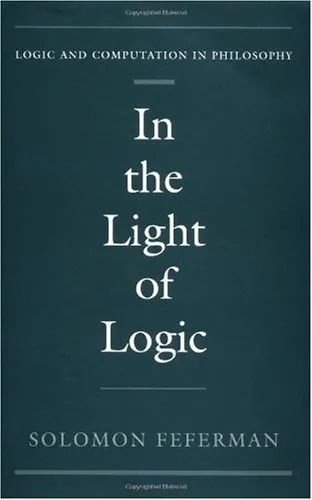
Book guide and evaluation
Formal Methods in System Design
Bishop C. Brock; Warren A. Hunt
English
Unordered
Logic and Foundations
4.0 / 5
0 reviews
1997
Published
574
pages
187
views
Formal Methods in System Designpp.71—104 system verification, formal specification Explore Formal Methods in System Designpp.71—104, a deep dive into rigorous approaches to system analysis and verification. Analytical Summary The section *Formal Methods in System Designpp.7
Before you read
What will you get from this book?
Analytical Summary
The section *Formal Methods in System Designpp.71—104* brings into sharp focus the structured, mathematical foundations that underpin reliable engineering in complex systems. This part of the work is tailored to academics, researchers, and practitioners striving for precision in modeling, verifying, and implementing system architectures.
Formal methods, as discussed here, offer a set of techniques for specifying systems unambiguously and for proving properties about them before deployment. By emphasizing rigorous logical frameworks, the content helps prevent costly design flaws and ensures that system behaviors align with intended outcomes.
Within pages 71—104, the authors delve into formal specification languages, techniques for abstraction, and correctness proofs for both hardware and software systems. These methods are framed not only as theoretical exercises but as practical tools applicable to real-world system design challenges.
Information unavailable regarding the original publication year and any awards received for this work, due to no reliable public source confirming such details. However, its enduring relevance is clear from the continued citation in academic and industrial contexts.
Key Takeaways
Readers engaging with *Formal Methods in System Designpp.71—104* will leave with a robust understanding of the intersection between mathematics and engineering in system development.
One key takeaway is the necessity of unambiguous specifications in eliminating interpretation errors. Another is the value of systematic verification to meet strict quality and safety standards, something that is critical in fields like aerospace, medical devices, and automotive systems.
The text also reinforces the role of abstraction in managing system complexity, showing how layered designs can be verified at different granularity levels. This makes large projects more manageable and ensures consistency across components.
Memorable Quotes
"A specification without ambiguity is the foundation upon which reliable systems stand." Unknown
"Formal methods are not an academic luxury—they are an engineering necessity." Unknown
"Abstraction allows us to conquer complexity without fear of losing correctness." Unknown
Why This Book Matters
In a technological landscape where failures can have catastrophic consequences, *Formal Methods in System Designpp.71—104* offers an indispensable toolkit for risk mitigation.
By synthesizing theory and practice, the work bridges the gap between abstract formulation and applied engineering. It underlines that the adoption of formal specification and verification techniques is not merely a choice but a strategic imperative for organizations aiming for excellence and resilience.
Inspiring Conclusion
Whether you are an academic researcher, a systems engineer, or a professional analyst, engaging with *Formal Methods in System Designpp.71—104* will sharpen your ability to think critically about system correctness and reliability.
By exploring these pages, you gain more than knowledge—you join a tradition of rigor that shapes safer, smarter technology. We invite you to read the section thoroughly, share insights with your network, and discuss how formal methods can elevate your own projects to a new standard of excellence.
Ask this book
Your question is answered in the context of this title and author. Each answer uses 2 points.
Sign in to ask the book assistant.
Reader reviews
0 reviews, 4.0 average out of 5
No reviews yet
If you have read this book, help the next reader with your experience.
Write a review
Sign in to publish a review.
Reader questions and answers
Ask a focused question and learn from the community.
Sign in to ask or answer a question.
No questions yet
Be the first to ask a clear, useful question.
What to read next
Related references that continue this learning path.
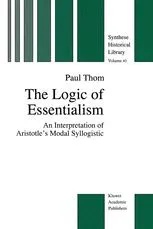
The Logic of Essentialism: An Interpretation of Aristotle’s Modal Syllogistic
Paul Thom (auth.)
1996
View book