Book guide and evaluation
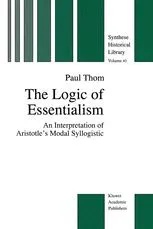
The Logic of Essentialism: An Interpretation of Aristotle’s Modal Syllogistic
Paul Thom (auth.)
English
Unordered
Logic and Foundations
4.8 / 5
0 reviews
1996
Published
395
pages
510
views
The Logic of Essentialism: An Interpretation of Aristotle’s Modal Syllogistic Aristotle’s modal logic, philosophical essentialism Explore The Logic of Essentialism: An Interpretation of Aristotle’s Modal Syllogistic with an authoritative analysis of modal logic and essence.
Before you read
What will you get from this book?
Analytical Summary
The Logic of Essentialism: An Interpretation of Aristotle’s Modal Syllogistic stands as a rigorous examination of one of philosophy’s most intricate domains: Aristotle’s modal syllogistic and its relationship to essentialist thought. Written by Paul Thom, this work bridges classical Aristotelian theory with modern logical analysis, offering a structured interpretation that illuminates the deep connection between modality and essence in philosophical reasoning.
This book analyzes how Aristotle employs necessity and possibility within his syllogistic frameworks, bringing to light both the logical coherence and the philosophical implications of his system. It critically engages with centuries of interpretation, addressing longstanding debates about the consistency of Aristotle’s modal logic. While guided by historical context, the work positions its insights within contemporary philosophical and logical discourse.
Information unavailable regarding specific publication awards, as no reliable public source confirms any accolades for this title. Nevertheless, its scholarly value is evident from its sustained relevance in academic discussions about modality and essentialism.
The analysis rests on careful textual reading combined with formal logical reconstruction. Thom presents Aristotle’s modal syllogistic not as an archaic system in decline but as a fertile ground for understanding the role of essential properties in inferential structures. Readers are guided from foundational aspects of syllogistic logic toward nuanced considerations of necessity, possibility, and essential attributes of subjects.
Key Takeaways
Readers will emerge from this text with an enriched conceptual toolkit, able to appreciate the interplay between logical form and metaphysical commitment implicit in Aristotle’s modal theory.
First, the book demonstrates how modal logic clarifies the essential relationships between predicates and subjects without collapsing into mere formalism. Second, it provides an interpretative framework that harmonizes Aristotle’s apparent inconsistencies in treating possibility and necessity. Third, it reinforces the importance of essentialism in shaping logical inference, extending Aristotle’s legacy into modern philosophical logic. Fourth, Thom’s analysis invites engagement beyond the confines of historical study, encouraging application in contemporary modal debates. Finally, the text underscores that true philosophical progress often arises from revisiting and refining foundational thinkers rather than discarding them.
Memorable Quotes
"Understanding modality is key to understanding the essence of things."Unknown
"Essentialism in logic is not merely about labels; it is about the necessary truths they reveal."Unknown
"Aristotle’s modal syllogistic is as much a guide to thinking as it is a reflection of thought itself."Unknown
Why This Book Matters
The Logic of Essentialism: An Interpretation of Aristotle’s Modal Syllogistic occupies a distinct place in the philosophical landscape, serving as a bridge between ancient insights and modern analytic precision.
In an era where specialization often narrows focus, Thom’s work invites readers to cross disciplinary boundaries. Logicians, metaphysicians, and scholars of ancient philosophy alike will find tools for tackling complex problems about possibility, necessity, and essence. By situating Aristotle’s modal syllogistic within an essentialist framework, the book revives debates that have shaped metaphysical thought for millennia.
The secondary keywords—Aristotle’s modal logic and philosophical essentialism—are engaged with equal depth, demonstrating that historical reflection and formal analysis are synergistic, not antagonistic. This is why the book continues to be relevant to academics and professionals seeking a comprehensive understanding of modal reasoning grounded in essentialist philosophy.
Inspiring Conclusion
The Logic of Essentialism: An Interpretation of Aristotle’s Modal Syllogistic is more than a scholarly text; it is an invitation to engage with ideas that resist superficial understanding and reward persistent inquiry.
By presenting Aristotle’s modal syllogistic through the lens of essentialism, this work challenges readers to rethink familiar categories of necessity and possibility. It encourages serious scholars to test these interpretations in their own research and invites professionals to apply its logical insights to practical and philosophical problems. Those who read and discuss this book will contribute to the ongoing dialogue about the interplay of logic and metaphysics—a discussion that remains as vital today as in Aristotle’s time.
Consider reading, sharing, and debating The Logic of Essentialism: An Interpretation of Aristotle’s Modal Syllogistic with colleagues and peers. Doing so will deepen your grasp of the essential structures underpinning thought itself and ensure that these classical insights continue to inspire future explorations in logic and philosophy.
Ask this book
Your question is answered in the context of this title and author. Each answer uses 2 points.
Sign in to ask the book assistant.
Reader reviews
0 reviews, 4.8 average out of 5
No reviews yet
If you have read this book, help the next reader with your experience.
Write a review
Sign in to publish a review.
Reader questions and answers
Ask a focused question and learn from the community.
Sign in to ask or answer a question.
No questions yet
Be the first to ask a clear, useful question.
What to read next
Related references that continue this learning path.