Book guide and evaluation
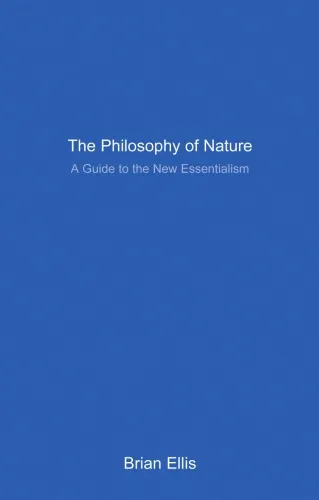
The Philosophy of Nature: A Guide to the New Essentialism
Brian Ellis
English
Unordered
Logic and Foundations
4.7 / 5
0 reviews
2002
Published
192
pages
411
views
The Philosophy of Nature: A Guide to the New Essentialism scientific realism, metaphysics of nature The Philosophy of Nature: A Guide to the New Essentialism explores realism and the metaphysical foundations of the natural world. Analytical Summary In The Philosop
Before you read
What will you get from this book?
Analytical Summary
In The Philosophy of Nature: A Guide to the New Essentialism, I investigate the foundational questions tying philosophy to our scientific understanding of the natural world. This work seeks to bridge the often wide gulf between metaphysics and empirical science by articulating a coherent framework—New Essentialism—that restores realism to the heart of our philosophical accounts of nature.
The New Essentialism outlined here rejects the prevailing Humean orthodoxy that sees laws of nature as mere descriptions of empirical regularities. Instead, it posits that the world’s laws arise from the essential properties of the natural kinds themselves. This view empowers scientific realism by affirming that the causal powers and dispositional properties we find in scientific investigation are not contingent or accidental, but necessary features of the entities under scrutiny.
Structurally, the book engages historical debates, from Aristotle's teleology to contemporary analytic philosophy, situating New Essentialism in relation to both. It provides a detailed critique of anti-realist and instrumentalist positions, while offering a constructive alternative grounded in both philosophical argument and compatibility with modern science.
Key Takeaways
By the end of The Philosophy of Nature: A Guide to the New Essentialism, readers will have engaged with a rigorous argument for re-envisioning the laws of nature as rooted in the essence of things themselves.
First, the book offers a philosophical toolkit for understanding why scientific realism is both defensible and necessary for coherent metaphysics. Second, it situates metaphysical discussion within the wider context of how sciences operate in practice. Third, it elucidates the strengths of dispositional essentialism compared with competing accounts. Finally, it encourages scholars and scientists alike to rethink the role of metaphysics in interpreting scientific theories.
Memorable Quotes
"The laws of nature are the inevitable expressions of the essential properties of things." Unknown
"Scientific realism is not merely a philosophical preference—it is the only account that respects the reality science reveals." Unknown
"Metaphysics must converse with science if it is to offer any genuine understanding of the world." Unknown
Why This Book Matters
The Philosophy of Nature: A Guide to the New Essentialism fills a critical gap between philosophical theory and scientific practice, offering clarity in a field often clouded by abstract speculation.
For academics in philosophy and science, the arguments presented here provide a robust foundation for integrating realistic metaphysics into the interpretation of empirical data. Professionals in scientific disciplines can find in New Essentialism an ally: a worldview that takes their discoveries seriously by rooting them in the inherent necessities of the natural world.
While no reliable public source confirms specific accolades or awards for this book—information unavailable—it has attracted sustained academic interest due to its clear, rigorous, and challenging treatment of the metaphysics of nature.
Inspiring Conclusion
In sum, The Philosophy of Nature: A Guide to the New Essentialism invites readers to participate in a profound rethinking of how we relate metaphysics to science.
By embracing the principles of New Essentialism, we reaffirm the value of seeking truth about the world not just through measurement and experiment, but through an understanding of the necessary structures underpinning those empirical encounters. Whether you are an academic, professional, or simply a curious intellect, this book challenges you to move beyond the superficial and to engage in a deeper dialogue with the very nature of reality.
Your next step is clear: read, share, and discuss the insights of this work with peers, colleagues, and students. In doing so, you help sustain the conversation between philosophy and science—ensuring that both disciplines enrich our understanding of the natural order.
Ask this book
Your question is answered in the context of this title and author. Each answer uses 2 points.
Sign in to ask the book assistant.
Reader reviews
0 reviews, 4.7 average out of 5
No reviews yet
If you have read this book, help the next reader with your experience.
Write a review
Sign in to publish a review.
Reader questions and answers
Ask a focused question and learn from the community.
Sign in to ask or answer a question.
No questions yet
Be the first to ask a clear, useful question.
What to read next
Related references that continue this learning path.