
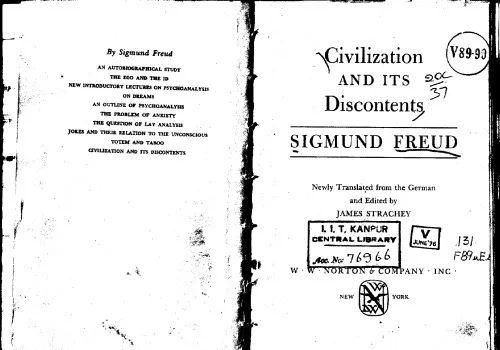
Civilization and Its Discontents
Sigmund Freud Translated From German And Edited By James Strachey.
1962
View book

Book guide and evaluation
Anne Power
0 reviews
Published
pages
views
Welcome to the profound exploration of an often-overlooked yet impactful topic in psychotherapy and psychoanalysis: forced endings. In 'Forced Endings in Psychotherapy and Psychoanalysis: Attachment and Loss in Retirement', we delve into the emotional, psychological, and relati
Before you read
Welcome to the profound exploration of an often-overlooked yet impactful topic in psychotherapy and psychoanalysis: forced endings. In 'Forced Endings in Psychotherapy and Psychoanalysis: Attachment and Loss in Retirement', we delve into the emotional, psychological, and relational dynamics that unfold when therapeutic relationships end prematurely, particularly in the context of retirement.
The book is a comprehensive investigation into the phenomenon of forced endings in therapeutic settings, highlighting the complex interplay of attachment, loss, and the challenging transition that therapists and clients face during retirement. It begins by defining what constitutes 'forced endings' within psychotherapy and psychoanalysis, then progresses to examine the various factors that influence these endings, including personal, professional, and systemic elements.
Each chapter is meticulously crafted to address different dimensions of forced endings. The journey starts with an exploration of attachment theory, offering insights into how attachment styles affect the therapist-client relationship. This is followed by a discussion on the psychological impact of retirement on therapists, with an emphasis on identity, loss of purpose, and the restructuring of self-concept.
Further, the book navigates through the emotional complexities that both therapists and clients experience, emphasizing the mutual loss and transition process. It integrates case studies, personal narratives, and empirical research to provide a holistic view of how these endings can be navigated thoughtfully and empathetically.
"The ending of a therapeutic relationship is not merely a professional conclusion but a deeply personal journey of loss and transformation."
"In exploring forced endings, we uncover the unspoken fears and the silent grief that accompany the inevitable process of saying goodbye."
This book is crucial for several reasons. Firstly, it sheds light on a topic that is often neglected in training and professional development, yet it is an integral part of the therapeutic journey. It provides practitioners with the knowledge and tools they need to handle terminations with greater sensitivity and competence.
Moreover, it serves as a valuable resource for understanding how forced endings affect not only the therapeutic alliance but also the individuals involved, encouraging therapists to approach these transitions with reflective practice and empathy. This awareness can lead to more effective and compassionate therapeutic practices and enhance the well-being of both therapists and clients.
Ultimately, 'Forced Endings in Psychotherapy and Psychoanalysis' addresses a gap in psychoanalytic literature by combining the theoretical with the practical, making it an indispensable guide for practitioners approaching retirement or those involved in handling therapeutic terminations.
Your question is answered in the context of this title and author. Each answer uses 2 points.
0 reviews, 4.8 average out of 5
Sign in to publish a review.
Ask a focused question and learn from the community.
Related references that continue this learning path.
Sigmund Freud Translated From German And Edited By James Strachey.

Sigmund Freud,James Strachey,Christopher Hitchens

Sigmund Freud;Alan Tyson (editor);Alix Strachey (editor);Anna Freud;James Strachey