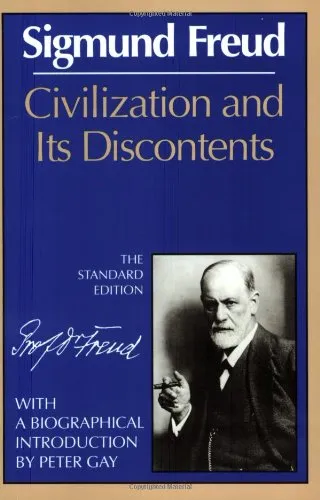
Civilization and Its Discontents (The Standard Edition)
Sigmund Freud,James Strachey,Christopher Hitchens
1989
View book
Book guide and evaluation
Sigmund Freud Translated From German And Edited By James Strachey.
0 reviews
Published
pages
views
Welcome to the intricacies of the human psyche and the monumental task of balancing individual desires with societal demands in Sigmund Freud's seminal work, "Civilization and Its Discontents." This book, published in 1930, delves deeply into the ongoing conflict between our
Before you read
Welcome to the intricacies of the human psyche and the monumental task of balancing individual desires with societal demands in Sigmund Freud's seminal work, "Civilization and Its Discontents." This book, published in 1930, delves deeply into the ongoing conflict between our quest for personal freedom and the constraints imposed by society in the pursuit of order and collective well-being. Freud, known as the father of psychoanalysis, provides a nuanced exploration of the driving forces of human behavior and the inevitable tensions that arise from our efforts to coexist.
In "Civilization and Its Discontents," Freud examines the fundamental tension between the individual's quest for freedom and society's need for order and conformity. Freud perceives civilization as a construct that imposes restrictions on individuals, curtailing their innate desires and instincts. He argues that this repression is necessary for the maintenance of social order, yet it results in a pervasive sense of frustration and discontent among individuals.
Freud explores the notion of the "oceanic feeling," a concept introduced by his friend Romain Rolland, representing a sensation of eternity and oneness with the universe. Although Freud does not personally subscribe to this feeling as a source of spirituality, he acknowledges its significance for those who experience it. He further elaborates on the role of religion as a societal construct that aims to provide solace from the restrictions imposed on individuals, yet often exacerbates the conflict between personal desires and societal expectations.
Throughout the book, Freud discusses the struggle between the pleasure principle and the reality principle, asserting that civilization demands individuals sacrifice personal happiness for the greater good. He suggests that human beings have an inherent aggressive instinct that civilization attempts to temper through cultural development and societal norms.
"The price we pay for our advance in civilization is a loss of happiness through the heightening of the sense of guilt."
"Most people do not really want freedom, because freedom involves responsibility, and most people are frightened of responsibility."
"One day, in retrospect, the years of struggle will strike you as the most beautiful."
Freud's "Civilization and Its Discontents" remains a cornerstone in understanding the psychological underpinnings of modern civilization. Its exploration of the human condition in juxtaposition with cultural expectations offers profound insights into the enduring nature of societal discontent. As we continue to navigate the challenges of individual versus collective needs, Freud's work serves as a reminder of the inherent complexities in balancing personal desires with societal obligations.
This book has influenced not only the field of psychology but also philosophy, sociology, and cultural studies. It invites readers to critically evaluate the constructs of civilization and to ponder the costs associated with progress and societal harmony. Freud's analysis provides a framework for examining contemporary issues of freedom, responsibility, and the psychological toll of living in a highly organized society.
Your question is answered in the context of this title and author. Each answer uses 2 points.
0 reviews, 4.6 average out of 5
Sign in to publish a review.
Ask a focused question and learn from the community.
Related references that continue this learning path.
Sigmund Freud,James Strachey,Christopher Hitchens
Sigmund Freud;Alan Tyson (editor);Alix Strachey (editor);Anna Freud;James Strachey